Curry and Indian cooking
Understand the spices, learn the techniques and build flavour step by step. We begin with a dry pan and move on to masala, different sauce foundations and marinades – with Indian cooking as the main focus.
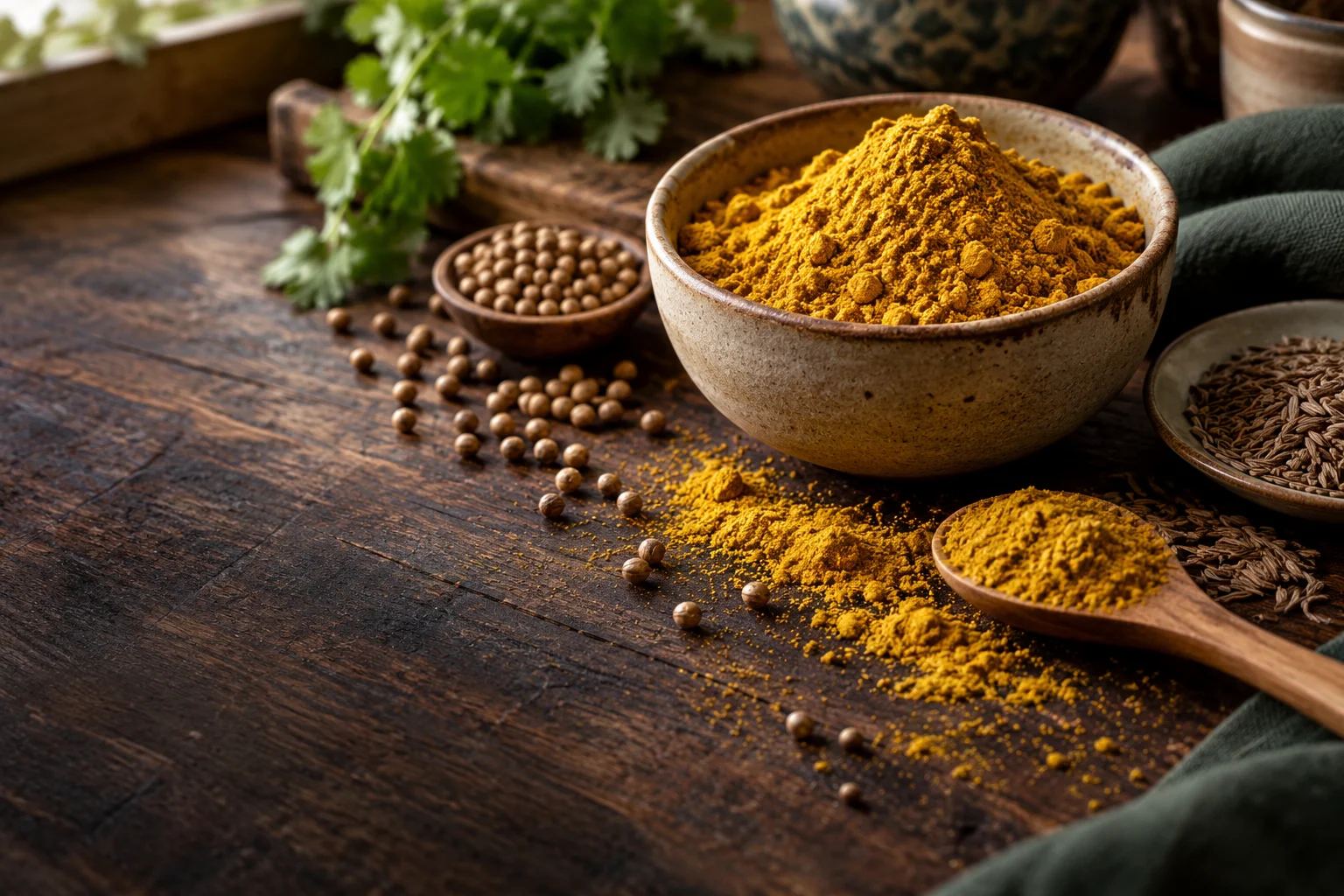
AI-generated illustration.
1067
When the spices woke up
My first big leap in cooking came when I began toasting spices in a dry pan before adding them to a dish. It was a real wow moment. Such a simple step could make such a big difference.
It sparked my curiosity: if the way we treat spices matters so much, what else could I bring out by understanding them better?
We bring that curiosity into the Sapidus curry guide. We will explore ingredients, flavours and the small steps that lift a dish.
The books that inspired me
My interest has been shaped in part by Indian Cooking by Madhur Jaffrey, The World’s Greatest-Ever Curries by Mridula Baljekar and Herbs & Spices: The Cook’s Essential Companion by Jill Norman. These books are personal sources of inspiration. The factual sources for this guide are listed below.
Curry is a blend. It is also food.
For many people, curry begins with a jar of yellow powder. But a curry can be mild and creamy, fresh and tangy, dark and robust or fiery with chilli. Some dishes have plenty of sauce; others are almost dry.
In Norwegian, we often use karri for the spice blend and curry for the dish. This distinction is useful, although the words are used interchangeably. Yellow curry powder represents only a small part of the flavours available. You do not need yellow curry powder to make a curry.
| Name | What is it? | Use |
|---|---|---|
| Curry powder | A dry spice blend, often containing turmeric, coriander seeds and cumin. | Seasoning for sauces, soups and casseroles. Formulations vary. |
| Garam masala | A family of aromatic spice blends. | During cooking or towards the end, according to the recipe. |
| Curry paste | A moist mixture of spices and aromatic ingredients. | A flavour foundation for particular dishes. Thai pastes have their own ingredient profile. |
| Curry leaves | Leaves from the curry leaf tree. | A distinct aromatic ingredient used, for example, in South Indian cooking. Not a substitute for curry powder. |
India has many cuisines
An onion-and-tomato base is useful to learn, but it is not the answer for the entire country. Korma, South Indian kurma, sambar and Bengali dishes using panch phoron illustrate different ingredients and methods. We use specific dish names when we know them, and explain when a recipe is adapted.
Spiced does not necessarily mean hot. Aromatic spices and chilli do different jobs. Reducing all the spices to lower the heat can also remove the flavour you wanted.
What does each spice contribute?
This is a practical flavour map. It is not a recipe in which everything should be used at once.
| Spice | Typical contribution | Practical advice |
|---|---|---|
| Coriander seeds | Citrusy, mild and slightly nutty aroma. | A useful starting point in many blends. |
| Cumin | Earthy, warm and distinct flavour. | Increase cautiously. Not the same as caraway. |
| Turmeric | Yellow colour and an earthy, slightly bitter flavour. | More does not automatically mean better curry flavour. |
| Fenugreek seeds | Distinctive, slightly bitter flavour and sweet aroma. | Use small quantities; avoid scorching the seeds. Seeds and dried leaves are different ingredients. |
| Mustard seeds | Sharp and nutty notes, depending on treatment. | Often used whole and heated in fat. |
| Cardamom | Fresh, perfumed and warm aroma. | Green and black cardamom give different results. |
| Cinnamon | Warm aroma and perceived sweetness. | Can round out flavour without added sugar. |
| Cloves | Strong, penetrating aroma. | A little goes a long way. |
| Fennel seeds | Sweet, anise-like flavour. | Takes the flavour in a different direction from cumin. |
| Chilli | Fruitiness, colour and varying heat. | Choose the variety for both flavour and heat. |
Coriander seeds and fresh coriander leaves give different flavour experiences. Disliking the leaves does not necessarily mean you dislike the seeds.
Dry-toasting – a small step with a big effect
A dry frying pan and some whole spices are a good place to begin. You need controlled heat and attention to aroma and colour.
Lightly and more deeply toasted spices give different results. Some Sri Lankan blends rely on a distinctly roasted character; others are used untoasted. The aim is not always the strongest possible toasted flavour.
- Measure first. Have a wide plate ready for cooling.
- Use a clean, dry pan. Start over medium-low heat. It does not need to be fiercely hot.
- Toast small quantities. Keep the spices reasonably evenly spread and move them often.
- Watch the aroma and colour. For light toasting, the aroma should become distinct without blackened areas or a burnt smell.
- Pour straight onto the plate. The pan keeps cooking even after the hob is switched off.
- Cool before grinding. Grind or crush once the spices are cold.
Spices vary in size and heat tolerance. When learning the technique, toast them separately. Let your senses guide you; one fixed time does not suit every pan, quantity and spice.
Divide some coriander seeds into two equal portions. Gently toast one and leave the other untoasted. Cool, crush separately and compare the aromas. Taste a little of each on warm, unsalted rice. Repeat later with cumin.
Not every spice should be dry-toasted. The recipe may call for untoasted spices or heating in fat. Start with whole spices; powder scorches more easily. Toasting will not make old, scentless spices fresh again either.
The next step: spices in fat
Heating spices in oil or ghee flavours the fat too. That seasoned fat then spreads through the dish. A tadka can be used early or poured over a finished dish, depending on the tradition and recipe.
| Technique | Method | Typical purpose |
|---|---|---|
| Dry-toasting | Spices heated in a pan without fat. | A toasted character, often before grinding. |
| Heating in fat | Whole spices heated in oil or ghee. | A flavour foundation or aromatic finish. |
| Spices in a moist base | Ground spices worked into onion, tomato or another base. | Builds the sauce’s main flavour. |
Whole and ground spices need different treatment
Have the remaining ingredients ready before heating whole spices in fat. This stage can happen quickly. Some seeds sizzle or pop, and the order must suit the mixture.
Ground spices burn more easily. Work them into a cooked onion mixture while controlling moisture. Have a little water or the next wet ingredient ready, and lower the heat if the mixture dries out.
Longer cooking will not repair burnt spices. An acrid, burnt smell is a signal to stop. If the flavour is clearly burnt, restarting the base is often best.
Onions determine more than you think
Soft onions with little browning give a milder foundation. Golden onions add more fried character. Well-browned onions can build a darker, stronger sauce but need attention towards the end. Burnt onion pieces taste bitter.
Do not use the same degree of browning for every dish. Follow the recipe and notice how the result changes. Also read the onion and garlic guide.
Build flavour through several additions
A curry need not receive all its spices at once. Whole spices can flavour the fat early, ground spices can form part of the base, and a little garam masala can add a clearer aroma towards the end. Fresh herbs or a tadka can finish the dish.
This is a working model, not a requirement to use every stage. Garam masala can also be used earlier; timing depends on the blend and the dish.
Masala – more than a spice powder
Masala often means a spice blend, but in recipes it can also refer to a moist paste or cooked flavour foundation. A jar of garam masala and an onion-and-tomato masala are different things.
Masala tells us that flavours are combined. The name alone does not tell us which ingredients were used.
Garam masala varies
Coriander seeds, cumin, cardamom, cinnamon, cloves and pepper are common ingredients. “Warming” refers to the aromatic character; the blend need not be chilli-hot. A teaspoon of a clove-heavy blend differs from a teaspoon dominated by coriander seeds. Smell it before using and begin cautiously.
Sambar powder has its own purpose
This blend is developed for sambar, with variations between traditions and households. It is more useful to learn it in its intended dish than to treat it as ordinary yellow curry powder.
Panch phoron is used whole
This five-spice blend is used in Bengali and other eastern Indian cooking. A common combination is cumin, fennel, fenugreek, mustard and nigella seeds. It shows how whole seeds provide both flavour and texture.
More bases give more dishes
A single base sauce can be practical, but its flavour carries through. If every dish starts with the same amounts of browned onion, tomato and spices, they will share much in common. We therefore learn several foundations.
Onion and tomato
Cook the onions to the degree of browning required. Add ginger and garlic without scorching them. Work in the spices and add tomato. Let the base cook together before adjusting the main ingredient and liquid according to the recipe.
Freshly added tomato tastes different from tomato cooked together with onion. Taste as you go and assess consistency. Visible fat around the edge is a checkpoint in some recipes, but you need not add more oil simply to force this effect.
Yoghurt, onion and nuts
This sauce can be full-bodied without tomato dominating. Yoghurt adds tang, ground nuts add body, and aromatic spices can take a clear role. Many North Indian korma variations use yoghurt, onion, nuts or seeds. Korma does not automatically mean “mild sauce with cream”.
Yoghurt in a sauce needs different handling from yoghurt in a marinade. Vigorous heating can split it; follow the recipe’s order and heat treatment. Finely ground nut paste gives a different consistency from roughly chopped nuts.
Coconut
Coconut milk, coconut cream and ground coconut give different body and texture. South Indian kurma may use coconut ground with spices, seeds or nuts. Coconut milk is not universal in Indian curry; use it because it suits the dish.
Tangy sauces
Acidity can be a defining quality worth retaining. Tamarind fish curry from Andhra Pradesh is one example. Tomato, yoghurt, tamarind, lemon and vinegar taste different and cannot be substituted one for one. Tamarind pastes and concentrates vary in strength; begin cautiously.
Dal: pulses build the dish
Dal refers to pulses and dishes made from them. Much of the body comes from the ingredient itself. Cook the pulses to the desired consistency and follow the dish’s seasoning method, during cooking or as a finishing tadka.
Not every curry needs lots of sauce
Some dishes have plenty of liquid, others a thick sauce coating the pieces, and others are almost dry. Do not add water out of habit. If a sauce needs prolonged reduction, remove cooked fish or chicken first to avoid overcooking it.
Also see the stock guide and the guide to oil, butter and ghee.
Marinating – flavour before the food meets heat
A good marinade coats the ingredient with spices and aroma and can affect its surface texture. It should suit both the ingredient and the cooking method.
Most spice flavour stays on or near the surface. Salt can move further in over time. Small pieces therefore receive more marinade flavour relative to their meat quantity than a whole roast. Marinade does not automatically tenderise tough meat all the way to the centre.
| Part | Example | Purpose |
|---|---|---|
| Salt | Fine salt or salty sauces. | Seasons the ingredient. Count every salt source. |
| Aroma | Spices, garlic and ginger. | Flavour and scent. |
| Acidic ingredient | Yoghurt, citrus or vinegar. | Acidity and an effect on surface texture. |
| Fat | Oil or fat in the yoghurt. | Distributes certain aromas and contributes to the coating. |
| Sweetness | Sugar or honey. | Balance and an effect on browning. |
Yoghurt makes a useful foundation
Thick plain yoghurt holds spices around chicken pieces and skewers. Chicken tikka is a good example. Very runny yoghurt can be strained a little. Avoid sweetened or flavoured yoghurt.
Yoghurt’s lactic acid behaves differently from the acids in citrus and vinegar. A mild yoghurt marinade may work overnight; a highly acidic lemon or vinegar marinade should not automatically have the same time. Longer marinating and more acid do not necessarily improve texture.
Timing: start cautiously
These are starting points for flavour and texture, not an extension of shelf life. Marinade strength and piece size matter greatly. Follow a specific recipe.
| Ingredient and marinade | Starting point |
|---|---|
| Chicken pieces, mild yoghurt marinade | 2–8 hours. Overnight may suit an adapted recipe. |
| Lamb, mild yoghurt marinade | 4–12 hours, according to cut and size. |
| Thin meat strips, low-acid marinade | 30 minutes–4 hours. |
| Fish, citrus-based marinade | Start with 15–30 minutes. |
| Raw peeled prawns, citrus-based marinade | Start with 10–20 minutes. |
| Paneer, spiced yoghurt | 30 minutes–2 hours. |
Weigh the salt
For unsalted meat with a small amount of marinade that remains during cooking, around 8 g fine salt per kilo of ingredient can be a cautious test starting point. For 600 g, that is about 5 g. This is not a fixed rule or a brine formula. Reduce it if the marinade contains other salty ingredients or the food will enter a salty sauce. Grams are more precise than spoons, especially when salt crystals differ in size.
Toast spices first if appropriate
Whole coriander seeds and cumin can be toasted, cooled and ground before mixing in. Cool fully before combining with yoghurt and ingredients that must stay cold. Toasting is a choice to suit the dish.
Prepare the surface before cooking
For pan-frying with a browned crust, drain thin excess marinade and gently dry if needed. For yoghurt-marinated skewers, let excess drip off while retaining a thin coating. Cook in batches. Sugar and honey can darken the outside before the centre is done.
Keep covered at 4 °C or colder. Follow the ingredient’s shelf life; marinating does not reset the clock. Reserve a clean portion before adding raw meat or fish if you want a cold sauce. Used raw-meat marinade must be boiled thoroughly before any use as a hot sauce. Acid does not make raw chicken safe to eat.
Mild yoghurt marinade for chicken
Test suggestion – not home-tested. Quantities are a starting point for 600 g boneless chicken thigh in even pieces. This is not recorded as a finished, home-tested Sapidus recipe.
| Ingredient | Quantity |
|---|---|
| Thick plain yoghurt | 120 g |
| Neutral oil | 10 g |
| Finely grated ginger | 10 g |
| Finely grated garlic | 6 g |
| Ground coriander seeds | 3 g |
| Ground cumin | 2 g |
| Turmeric | 0.5 g |
| Mild chilli powder | 0.5–1 g, depending on strength |
| Fine salt | 5 g |
- Mix the marinade and coat the chicken. Cover and refrigerate for 4–8 hours.
- Preheat the oven to 220 °C conventional heat. Let excess marinade drip off and place the pieces in one layer with some space in a suitable ovenproof dish.
- Roast until the chicken is cooked through. Begin checking after about 15 minutes; timing depends on piece size and oven. Use a clean meat thermometer in the largest pieces: at least 74 °C at the centre. Colour alone is not a reliable check.
- Serve with rice and suitable accompaniments. Do not use leftover raw-meat marinade as a cold sauce.
The first test has no extra lemon, so the yoghurt’s acidity can be assessed. Serve lemon on the side if desired. Note salt level, the balance of coriander and cumin, garlic strength and how the coating behaves. Time and temperature are guidance; home testing remains to be done.
Taste before adding more spice
Put a little sauce in a cup and try an adjustment there first. Compare before changing the whole pot.
| Problem | Check | Possible adjustment |
|---|---|---|
| Flat flavour | Salt, excess liquid or too little freshness. | Adjust salt cautiously, reduce or try a little suitable acid. |
| Too hot | Too much chilli relative to everything else. | Increase with unseasoned sauce base and ingredients suited to the dish. |
| Too bitter | Burnt onions/spices or too much of a bitter spice. | Find the cause. A clearly burnt flavour is hard to rescue. |
| Too acidic | Tomato, yoghurt, tamarind or another acid. | Dilute or round out with a suitable sauce foundation. |
| Too sweet | Sugar, sweet vegetables or a sweetened product. | Try small adjustments with salt and suitable acid. |
| Too thin | Excess liquid or too little body. | Reduce uncovered or use the dish’s intended way of adding body. |
| Too heavy | Lots of fat, very thick sauce or too little freshness. | Try a little liquid, suitable acid or fresh herbs. |
Sugar does not remove acid, and coconut milk does not remove chilli. They can change the perception, but also the dish’s character. If you want more spice flavour, identify what is missing: cumin, cardamom and chilli do different jobs.
Read more in the flavour balance guide and the sauce guide.
Learn one direction at a time
Start with a specific dish and make it several times. Note spices, quantities, liquid and cooking method. Change one or two things at a time. This makes it easier to understand what actually improves the food.
Three useful directions to explore are an onion-and-tomato chicken curry, a yoghurt-and-nut dish and a dal finished with tadka. Recipes and test notes must be developed for each; they are not finished recipes in this guide.
A good curry does not need the greatest number of spices. It needs ingredients, spices and technique that work together.
Also visit the curry spice sheet · 1028 or Kitchen chemistry.
Sources and further reading
Source research is AI-assisted. Kitchen examples, proposed tests and troubleshooting are Sapidus’ practical applications of the source material.
- Swasthi Shreekanth – curry powder and ingredients ↗
- Swasthi Shreekanth – garam masala ↗
- Ashima Goyal Siraj – separate dry-toasting and cooling ↗
- Dini Kodippili – toasted and untoasted curry blends ↗
- Swasthi Shreekanth – korma and different sauce foundations ↗
- Swasthi Shreekanth – South Indian vegetable kurma ↗
- Neha Mathur – panch phoron ↗
- Swasthi Shreekanth – sambar powder ↗
- Sahil Makhija – tamarind fish curry from Andhra Pradesh ↗
- Swasthi Shreekanth – yoghurt-marinated chicken tikka ↗
- Nik Sharma – kitchen experiments with yoghurt marinades ↗
- AmazingRibs – what marinades penetrate ↗
- USDA FSIS – refrigerated marinating and handling used marinade ↗
- USDA FSIS – chicken, marinating and safe cooking ↗