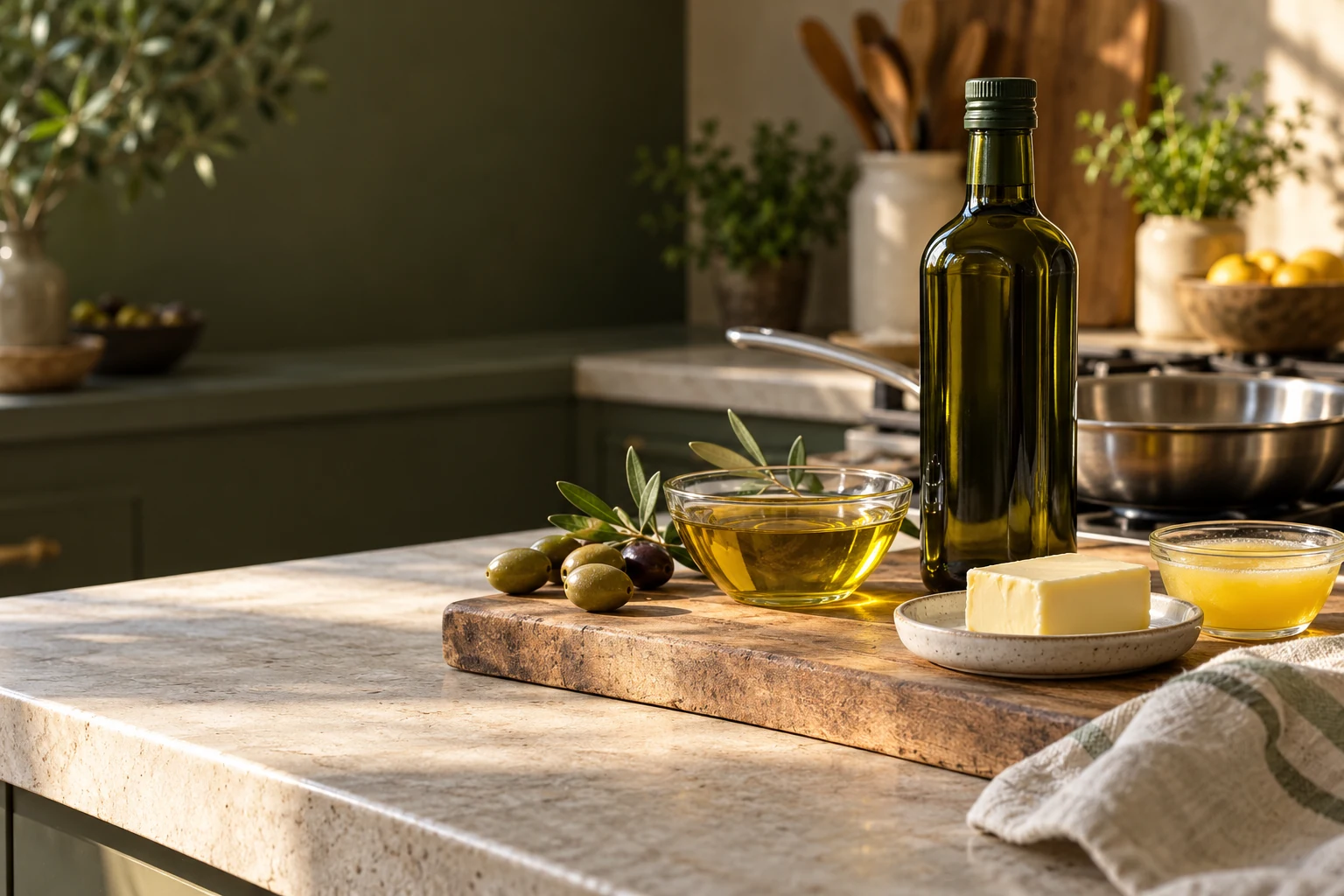
The right fat. Better food.
Sometimes fat simply helps food cook in the pan. At other times, its flavour is the point. Here we choose oil and butter according to the dish, the heat and the result you want.
AI-generated illustration.
What should the fat do?
First choose between neutral help in the pan and a flavour you want to notice. Then consider the heat. One bottle can suit several tasks; you do not need a cupboard full of specialist oils.
An olive oil you like, a neutral refined frying oil, and butter when the dish needs its flavour or properties. Add finishing oils and ghee as needed. If you mainly use olive oil day to day, that is a practical starting point.
| What you are making | A good choice | What matters |
|---|---|---|
| Onion base for soup or ragù | Olive oil or refined rapeseed oil | Moderate heat and time to soften. See the onion guide too. |
| Steak and browned stewing meat | A suitable frying oil; alternatively clarified butter or beef tallow | A dry surface and small batches. Add regular butter later if you want its flavour. |
| Fish and eggs | Butter, olive oil or a neutral oil | Use controlled heat. The butter should not blacken while the food cooks. |
| Mushrooms for browning | Olive oil or a neutral frying oil | A wide pan and room for evaporation matter more than extra fat. |
| Oven-roasted potatoes and vegetables | Olive oil or an oil labelled for frying; beef tallow for potatoes when you want a meaty note | Apply a thin coating. The oven setting is not the temperature of the fat itself. |
| Stir-frying and deep-frying | Refined oil intended for the task | Follow the product instructions. Deep-frying needs temperature control; oil should not be left smoking. |
| Salad, pesto and finishing dishes | An oil whose flavour you enjoy | This is where fruity olive oil, cold-pressed rapeseed oil or a little flavoured oil can shine. |
| Cakes, biscuits and yeast baking | The fat the recipe was developed for | Liquid oil, softened butter and melted butter do different jobs. Do not substitute blindly gram for gram. |
Use the onion guide for a soft base, the steak guide for browning and the mushroom guide when mushrooms need colour.
Look at the bottle, not just the ingredient.
Refining often produces a milder flavour and changes heat performance. Cold-pressed oils usually retain more of the original ingredient’s character. But “cold-pressed” does not automatically mean “cold use only”, and a plant name is not a complete set of instructions.
| Fat | Flavour and character | Good uses | Remember |
|---|---|---|---|
| Extra virgin olive oil | Fruity, green, mild or peppery | Dressings, finishing, vegetables and everyday pan-frying | Yes, it can be used for frying. Control the heat; consider saving a particularly aromatic oil for finishing. |
| Olive oil containing refined oil | Often a milder olive flavour | Frying and oven dishes when you want less flavour from the oil | Read the ingredients: regular olive oil is often a blend of refined and virgin olive oil. |
| Refined rapeseed oil | Mild and neutral | Versatile frying, roasting, mayonnaise and oil-based baking | A practical choice when the ingredients or spices should lead the flavour. |
| Cold-pressed rapeseed oil | More seed flavour, often nutty | Dressings, cold sauces and dishes where you want its flavour | Do not assume it behaves like refined rapeseed oil under heat. Follow the instructions on the bottle. |
| Refined sunflower oil | Usually neutral | Frying or baking according to the product instructions | Specific high-oleic and frying varieties are available for prolonged heating. These are not interchangeable with every sunflower oil. |
| Refined groundnut oil | Often mild | Stir-frying and frying when the product is intended for them | Groundnut oils vary. Check the label, including any allergy considerations. |
| Avocado oil | From distinctly green to fairly neutral | Cold use or frying, depending on the product | Refined and unrefined avocado oil should not be treated as the same product. |
| Toasted sesame oil | Strong, toasted and nutty | Small amounts in dressings or to finish noodles and vegetables | Use it as a seasoning. Do not automatically choose it as the main oil for a very hot wok. |
| Walnut oil and flaxseed oil | Walnut: nutty. Flaxseed: its own seed flavour | Cold use according to the label; walnut oil can suit dressings | These are not our default choices for high-heat frying. Buy small bottles and follow the storage instructions. |
| Coconut oil | Virgin usually tastes of coconut; refined is milder | Dishes and baking where its flavour and solid consistency fit | It can solidify in cool conditions. It will not necessarily give the same result as a liquid oil. |
| Regular butter | Distinct butter flavour, with potential nutty notes when browned | Eggs, fish, gentle frying, sauces and baking | The milk solids can brown and then burn. Watch the colour and control the heat. |
| Clarified butter and ghee | Butterfat; ghee often has a deeper nutty flavour | Frying when you want butterfat with fewer milk solids | Tolerates more heat than regular butter. It still cannot withstand unlimited heating. |
| Beef tallow | From mild to distinctly meaty, depending on the raw fat and rendering | Roast potatoes, chips and browning meat | Choose rendered and purified food-grade tallow. It tolerates relatively high cooking heat but should not be left smoking. High in saturated fat. |
| Margarine and liquid cooking fat | Varies from neutral to buttery | Frying or baking when the product is designed for it | Frying margarine, baking margarine and reduced-fat spreads have different properties. Check the intended use. |
The table offers cooking choices, not a guaranteed maximum temperature for every product. The formulation and manufacturer’s instructions take priority over a general oil name.
Yes, you can fry with olive oil.
Olive oil suits much everyday pan-frying. Extra virgin is not reserved for salad either. Use it for onions, vegetables and dishes that suit its flavour. A milder refined frying oil can be practical for more intense browning.
An expensive, aromatic extra virgin may make more difference drizzled over the finished dish than during a long frying session. That is a choice about flavour and cost, not a ban on heating the oil.
In Sapidus Bœuf Bourguignon Sans Vin we use olive oil for browning. Work in batches and watch the pan. We want a browned surface, not a cloud of smoke.
The smoke point is one piece of information, not the whole answer.
The smoke point describes when a fat starts producing visible smoke under particular conditions. It varies with factors including refining and quality. On its own, it does not tell you how well an oil withstands prolonged heating.
We therefore do not give one precise temperature as the truth for every bottle with the same name. Consider the product, the time on the heat and what actually happens in the pan. The oven setting does not directly tell you the temperature of a thin oil coating on moist vegetables either.
It smokes before the food goes in
Take the pan off the heat and let it cool. Replace the fat if it has scorched or smells acrid. Next time, use less heat or preheat for less time.
The food stays pale and wet
There is often too much food in the pan. Dry the ingredients and cook in smaller batches. More oil will not automatically solve the problem.
Is the highest smoke point always best?
Choose for the task. Flavour, prolonged heating and intended use matter too. A dressing oil does not need to win a highest-temperature contest.
The hob is always on maximum
A heavy pan retains heat well. Reduce the heat after preheating when needed. Let the food and cooking fat guide you rather than using the same setting out of habit.
Melted, browned, clarified and ghee.
Regular butter
Contains fat, water and milk solids. It melts and foams in the pan. The milk solids can brown deliciously, but become bitter if burnt. Salted and unsalted butter give different control over seasoning.
Brown butter
Here the milk solids turn golden brown for a nutty flavour. Stir and watch the colour at the bottom, not just the foam. Pour into a heatproof bowl when browned enough so residual heat does not burn it.
Clarified butter
Butter is heated gently and the clear butterfat is separated from water and milk solids. Removing the solids allows it to tolerate higher temperatures than regular butter. Simply melting butter is not the same as clarifying it.
Ghee
A form of clarified butter whose preparation often develops a more pronounced nutty character before the milk solids are strained out. Flavour varies between products. Choose ghee when that character suits the dish.
Oil and butter can be mixed for flavour, but the oil does not remove the solids that can burn. Continue to control the heat for the butter. For steak, you can begin with oil, reduce the heat and add a little butter towards the end if desired.
Try a little brown butter as a flavouring for potatoes or fish. Start small: it should suit the ingredient and the rest of the dish.
Beef tallow.
Beef tallow is rendered and purified cattle fat. It is solid at room temperature and melts in the pan. Its flavour depends on the raw fat and how thoroughly it is purified: some products are mild, others taste more distinctly meaty.
Use it for roast potatoes, chips or browning meat when the flavour fits. For potato wedges, melt the tallow and toss it through to create a thin, even coating before roasting. Space on the tray and controlled heat are still important for a crisp surface.
Purified beef tallow tolerates relatively high cooking temperatures, but heat performance varies by product. Follow the manufacturer’s instructions and do not leave it smoking. Choose tallow intended for cooking.
Tallow is high in saturated fat. For heart health, olive and rapeseed oils are better everyday choices when replacing fats high in saturated fat. Tallow can be used occasionally when you want this particular result.
Can oil replace butter?
Sometimes, but there is no universal substitution rule. Softened butter can be creamed with sugar to build structure. Oil stays liquid and produces a different result. Butter also contains water and milk solids; oil is largely pure fat.
For a cake developed with oil, choose an oil with the flavour you want. For biscuits, shortcrust pastry or recipes requiring butter and sugar to be creamed, follow the butter specification until you have a tested adaptation. A fat-content ratio alone cannot reproduce butter’s properties.
In focaccia olive oil is part of both the flavour and the method. For a sauce made with a butter roux, any substitution must be considered for that specific recipe.
Do not keep oil beside a hot hob.
Heat, light and air accelerate rancidity. Keep oil tightly closed in a cool, dark place according to the manufacturer’s advice. Buy a bottle size you will use within a reasonable time, especially for oils used only occasionally.
Finishing oils and some cold-pressed oils may need refrigeration after opening. Keep butter and homemade clarified butter refrigerated. Use clean utensils and avoid introducing food scraps into the container.
If oil smells rancid or tastes unpleasantly stale, heating will not make it fresh again. Bitterness and peppery notes, however, can be natural in fresh extra virgin: consider the whole flavour, not just one note.
A small kitchen test: taste the same bread with two different oils. At your next meal, compare a mild oil and a little butter with the same ingredient. Discover what you enjoy before filling the cupboard.
Sources and further reading
Source research is AI-assisted. Kitchen examples, proposed tests and troubleshooting are Sapidus’ practical applications of the source material.
- International Olive Council – olive oil and frying ↗
- Norwegian Directorate of Health – regular and extra virgin olive oil ↗
- MatPrat – butter, margarine and frying oil ↗
- TINE – clarified butter and milk solids ↗
- Serious Eats – comparative baking tests with butter and oil ↗
- Serious Eats – brown butter technique ↗
- Kikkoman – toasted sesame oil as a seasoning ↗
- Utah State University Extension – fats, oils and rancidity ↗
- Bon Appétit – ghee and clarified butter compared ↗
- Montana State University Extension – beef tallow in cooking ↗
- American Heart Association – saturated and unsaturated fat ↗
- Findus – high-oleic oil for prolonged heating ↗