Give mushrooms room. Bring back the flavour.
From dependable button mushrooms to full-flavoured shiitake: choose the mushroom for your dinner, control the liquid and let the pan build flavour.
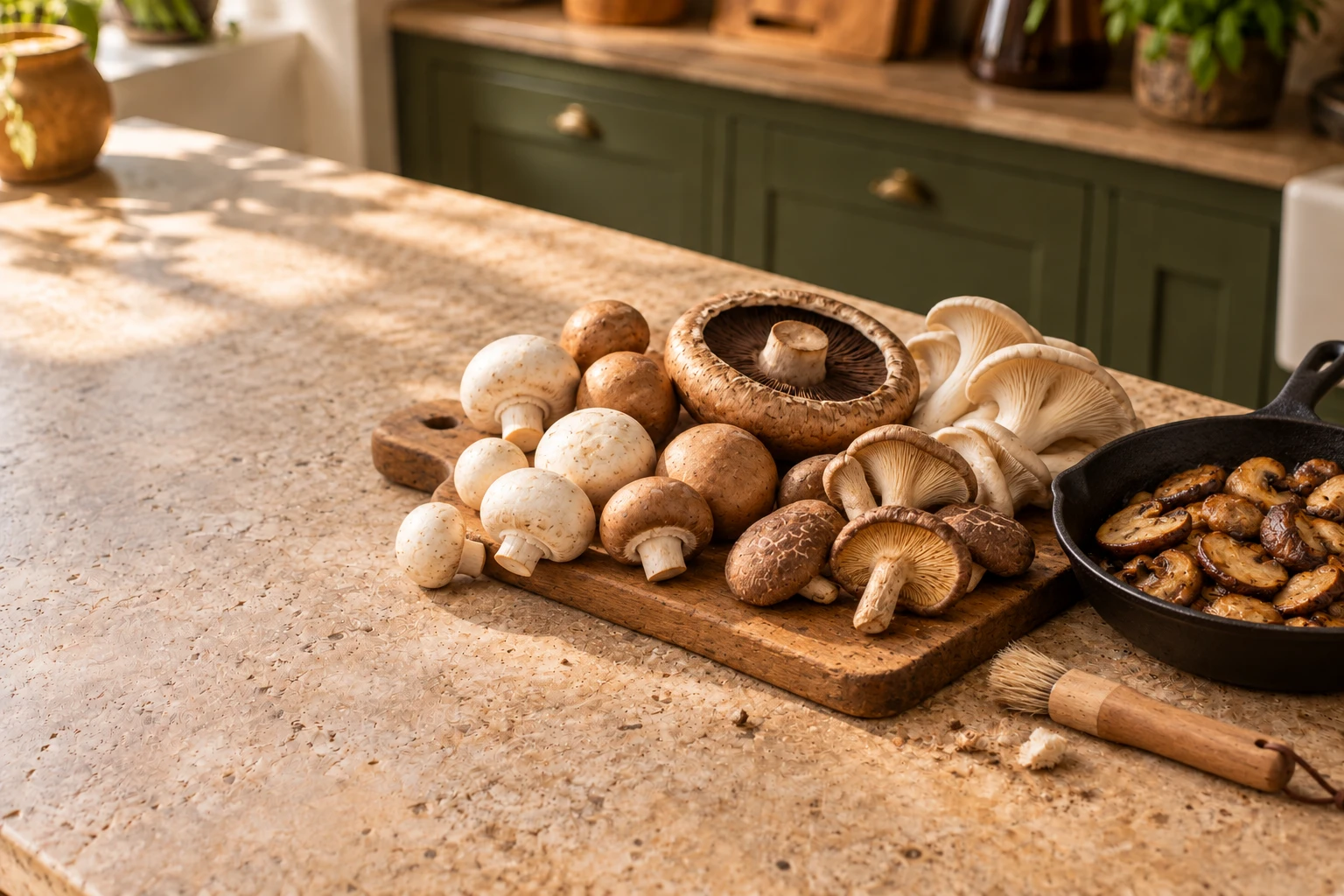
AI-generated illustration.
Eight mushrooms. Different kitchen jobs.
Mild button mushrooms leave room for the rest of the food. Chestnut mushrooms give a more pronounced mushroom character, while shiitake often adds more of its own distinctive flavour. Choose for the flavour and texture you want, rather than just the size of the cap.
| Mushroom | Flavour and bite | A good place to start |
|---|---|---|
| White button mushroom | Mild and firm | A versatile everyday mushroom for sauce, omelette, pizza and stews. |
| Chestnut mushroom | Fuller and more pronounced than white button mushrooms | Our first choice when meat stew or mushroom sauce needs a little extra depth. |
| Portobello | Large, open brown button mushroom with a satisfying bite | The large cap suits stuffing and baking. Cut into chunky pieces for the pan. |
| Oyster mushroom | Firm flesh, delicate caps and distinct mushroom flavour | Tear into pieces for stir-fries, cooked sides or pasta. Trim away the tough shared base. |
| Shiitake | Distinctive, full flavour | Good when curry, stir-fries and soups need a stronger mushroom character. Remove tough stems. |
| King oyster mushroom | Firm, nutty and substantial | Use both the cap and thick stem. Slice lengthways and fry as a separate side dish. |
| Chanterelle | Firm and aromatic with a peppery finish | Let it take centre stage as a fried side, creamed mushrooms or in a simple sauce. |
| Porcini | Gently nutty and full-flavoured | Good for pasta, risotto and sauce. A small amount of dried porcini gives plenty of flavour. |
Ingredient characteristics are based on FRUKT.no, linked from each name. Suggested uses and choices for our own dishes are Sapidus’ kitchen assessments.
Use edible mushrooms from a known supplier or mushrooms that have been reliably identified. The illustration and table are not identification aids. Wild mushrooms you are unsure about should be assessed by a mushroom expert. Find mushroom identification services through Helsenorge ↗
The cap is not the whole story.
Brush away soil and debris, and trim dry or damaged areas. A small brush or knife is useful. Clean just before cooking; mushrooms do not need to sit in a water bath. FRUKT.no recommends brushing rather than rinsing.
White button and chestnut mushrooms
Fresh stems can be used. Trim a dry end and cut the remainder along with the cap. Finely chop them if you want them to blend into a sauce.
Shiitake
The stem can be tough and fibrous. Remove the hard part and use the cap in the dish. Clean stems can infuse a stock and be strained out afterwards.
Oyster mushrooms
Trim away the tough base holding the cluster together. Tear or cut the rest into suitable pieces so the delicate edges contact the pan.
King oyster mushrooms
The thick stem is a large part of the appeal here. The whole mushroom can be used. Lengthways slices give a large cooking surface and a definite bite.
Feel the ingredient: ‘remove the stem’ is not a rule for every mushroom. Distinguish a fresh, firm stem from a hard or dried-out part.
Heat treatment is part of preparation.
FRUKT.no recommends cooking mushrooms before eating. Always follow instructions for the mushrooms you bought; a quick browning is not a universal cooking rule for every species.
Button mushrooms should not be eaten raw. To reduce phenylhydrazine content as much as possible, Mattilsynet recommends boiling before frying: put the mushrooms in cold water, bring to the boil and boil for about 10 minutes. Discard the cooking water. Drain well before browning. Liquid from canned button mushrooms should not be used as stock either. Read Mattilsynet’s full advice ↗
Chestnut mushrooms and portobello are also varieties of the button mushroom. Take this into account when choosing a method. Boiling in water and dry-frying in a pan are different processes: boiling involves discarding the water, while dry-frying evaporates the mushrooms’ own liquid.
First the liquid goes. Then browning begins.
When the pan fills with liquid, mushrooms initially cook in their own juices. That is normal. The problem comes when you stop there. A wide pan and smaller batches give liquid a way out and mushrooms a chance to colour.
Cut to a suitable size
Use even slices or chunky pieces to suit the dish. For stew, we like pieces still noticeable when the dish is finished. For sauce, cut smaller.
Choose a wide pan
Heat over medium-high heat. Spread mushrooms in an uncrowded layer; cook in batches if packed tightly. Reduce the heat if the base scorches.
Let the liquid evaporate
For dry-frying, start without fat and let the mushrooms release liquid. Stir occasionally. Previously boiled mushrooms must drain thoroughly first. This method needs a pan that tolerates the heating; follow the manufacturer’s guidance for non-stick coatings.
Add a little olive oil and leave them alone
Once most liquid has gone, add a little olive oil. Give the surface time to brown between turns. Butter at the end is optional. Garlic goes in late so it does not burn while water evaporates.
Season and finish the dish
Season with salt and pepper. Fold into a sauce or stew, or serve as a side. To retain browning, wait until the mushrooms have coloured before adding cream or stock.
The principle of dry-frying, evaporation and adding fat afterwards is described by MENY. Using olive oil as standard and the advice on size and pan contact are Sapidus’ practical adaptations.
One ingredient, three different roles.
For beef stew
Choose chestnut or white button mushrooms in chunky pieces. Cook and brown separately, then add to the stew with about an hour remaining, as in Bœuf Sans Vin. The stew gains mushroom flavour without everything cooking as long as the chuck.
For Thai curry
Chestnut mushrooms are a good starting point. Shiitake is an alternative when you want a stronger mushroom flavour. Brown before adding coconut milk; the curry liquid will not do that job. See our red curry.
For fresh pasta
Brown mushrooms well, then bring together with a little pasta water and fat for a simple sauce. Chanterelles or porcini can take the lead, while chestnut mushrooms are a good everyday choice. Start with our fresh egg pasta.
As a separate side
Lengthways king oyster slices or torn oyster mushrooms give larger pieces with a distinct bite. Serve with a little pepper and perhaps a few drops of lemon after frying. A side dish need not drown in sauce.
Dried mushrooms build flavour.
Dried porcini or shiitake can add depth to stock, sauce and stews. Start cautiously: you can add more flavour but cannot pick it back out. This does not necessarily replace the texture of fresh mushrooms.
Follow the pack
Soak and cook according to product instructions. Time, water quantity and subsequent treatment vary.
Lift the mushrooms out
Leave any sand and debris on the bottom. Cut the mushrooms if needed and continue cooking as directed.
Assess the soaking liquid separately
Use it only if the product instructions permit. Filter out sediment and include it in further heat treatment. This applies to soaking liquid from suitable dried edible mushrooms, not boiling water that must be discarded.
Four common problems and what you can do.
Grey and watery
There is still plenty of liquid, or the pan is too full. Let the liquid evaporate and cook the rest in smaller batches. Do not add cream yet if browning is the goal.
Burnt outside
The heat is too high for the pieces or fat being used. Lower the heat and allow time to cook through. Blackened garlic tastes bitter; add it later next time.
Tough pieces
Check for tough shiitake stems or oyster-mushroom bases. Thickness and cooking also matter. Cut to suit the ingredient rather than using one size for everything.
The mushroom flavour disappears
A large amount of stock or cream can dilute the flavour. Reduce the sauce before bringing the dish together, or use more browned mushrooms. Adjust salt before deciding to add further ingredients.
Buy fresh. Keep cool. Use soon.
Choose firm, fresh mushrooms without slime or obvious damage. Refrigerate according to the pack, ideally in suitable packaging or a paper bag. Avoid keeping them damp and tightly enclosed. Shelf life varies with variety and freshness at purchase.
Cool cooked mushrooms quickly and refrigerate if keeping them. For freezing, mushrooms can be cooked first and divided into small portions; expect possible texture changes. Follow product instructions for the species being used. More on storage and freezing from MENY ↗
Sources and further reading
Source research is AI-assisted. Flavour combinations and choices for Sapidus dishes are our practical applications of the source material.
- FRUKT.no – mushrooms, cleaning and storage
- FRUKT.no – chestnut mushrooms
- FRUKT.no – shiitake
- FRUKT.no – oyster mushrooms
- FRUKT.no – king oyster mushrooms
- FRUKT.no – chanterelles
- FRUKT.no – porcini
- Mattilsynet – button mushrooms and cooking
- MENY – cooking, storage and freezing
- Helsenorge / Poison Information Centre – mushroom identification