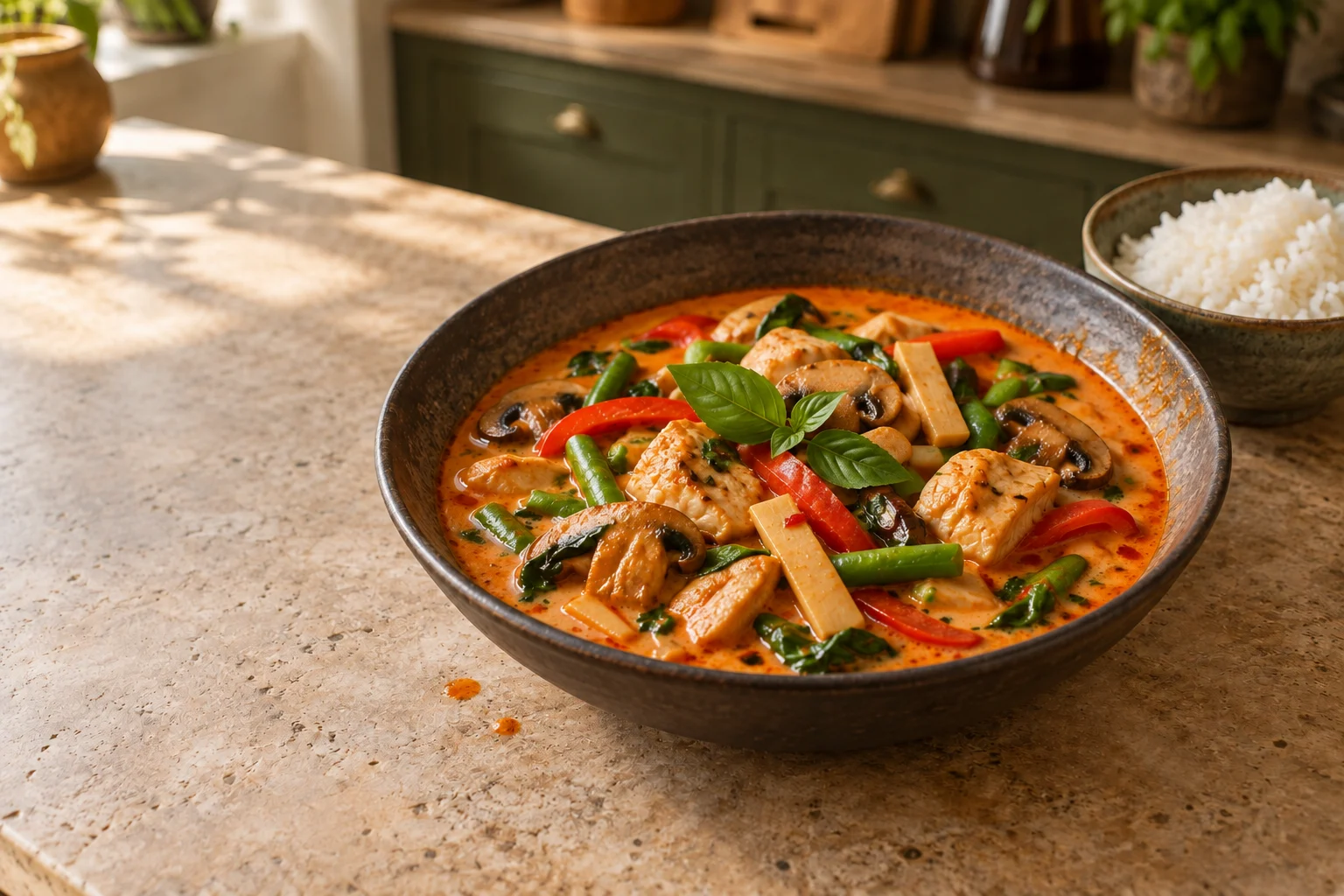
Thai red curry with chicken
Rich coconut, red curry paste and juicy chicken thigh. Mushrooms are browned, vegetables retain a little bite, and lime and basil go in at the very end.
Jump to the recipe ↓AI-generated illustration.
Optional: keep the screen awake while following the recipe. Uses more battery.
All recipes start at 4 people.
Ingredients now shown for 4 people.
Cuisine: Thai-inspired
Estimated timing: about 20 min preparation · about 35 min cooking · about 5 min resting. These estimates describe the basic method and are not measured kitchen timings. Follow the method and any time ranges above.
Method
Prepare everything
Cut chicken into even pieces about 3 cm across. Cut vegetables and measure sauce ingredients. Wipe mushrooms clean and remove dry stalk ends; the rest of the stalk can be used. Keep raw chicken and its utensils separate from the vegetables.
Brown mushrooms separately
Heat the frying pan well. Use about one third of the oil and fry mushrooms in two batches until coloured and most liquid has evaporated. Set aside. Too many mushrooms in the pan at once produce more boiling than browning.
Sweat the onion
Heat the remaining oil in the casserole over medium heat. Soften onion until translucent for 5–7 minutes without heavy browning. Add garlic and ginger for the last minute. Add curry paste and optional chilli and cook, stirring, for 2–3 minutes. Reduce the heat if it starts sticking.
Build the sauce
Add about one quarter of the coconut milk, preferably its thickest part. Simmer for a few minutes until clearly fragrant and perhaps a little fat shows on the surface. Coconut milk containing stabilisers may not split – do not boil it dry to force this. Stir in the remaining coconut milk, stock, fish sauce, sugar, lemongrass and lime leaves. Simmer for 5 minutes.
Poach the chicken in the sauce
Add chicken to the hot sauce and return to a gentle simmer. Cook gently for about 10–12 minutes. Avoid rapid boiling. Start the rice so it finishes at roughly the same time as the curry.
Add vegetables in stages
Add peppers and bamboo shoots and simmer for about 4 minutes. Add beans and browned mushrooms and continue for 3–4 minutes. Beans should be hot throughout and as tender as you prefer. Check the thickest chicken piece with a thermometer: at least 75 °C. Timings are approximate; piece size and heat determine cooking.
Adjust the flavour
Remove lemongrass and whole lime leaves. Take off the heat and add lime gradually. Taste and add more fish sauce if needed, and a little sugar if necessary. Fold in Thai basil. Let the curry settle for 5–10 minutes and serve with hot jasmine rice.
Get to know the spices in this dish
Good to know before you cook
Curry paste – use the scales
Tablespoons of firm curry paste vary considerably. Weigh the listed quantity. Aroy-D can be hot; use only two thirds to three quarters of the stated amount and omit extra chilli for a milder curry. Different brands may have entirely different strengths.
Stock should add depth
The listed stock quantity assumes concentrated stock. If you only have ordinary stock, use the same quantity and adjust seasoning. Do not double the liquid to obtain more stock flavour – that thins the sauce. Salted stock often means less fish sauce.
If the sauce is too thin
Reduce the sauce uncovered before adding chicken. If the dish is already cooked, lift out chicken and vegetables before reducing. This prevents overcooking. Return them and heat through.
A generous Sapidus variation
This is a generous curry with mushrooms and several vegetables. Ginger tastes different from galangal, and ordinary basil is a possible but differently flavoured substitute for Thai basil.
What happens in the food?
Sources and further reading
Source research is AI-assisted. Practical suggestions and flavour assessments are Sapidus’ applications of the source material.