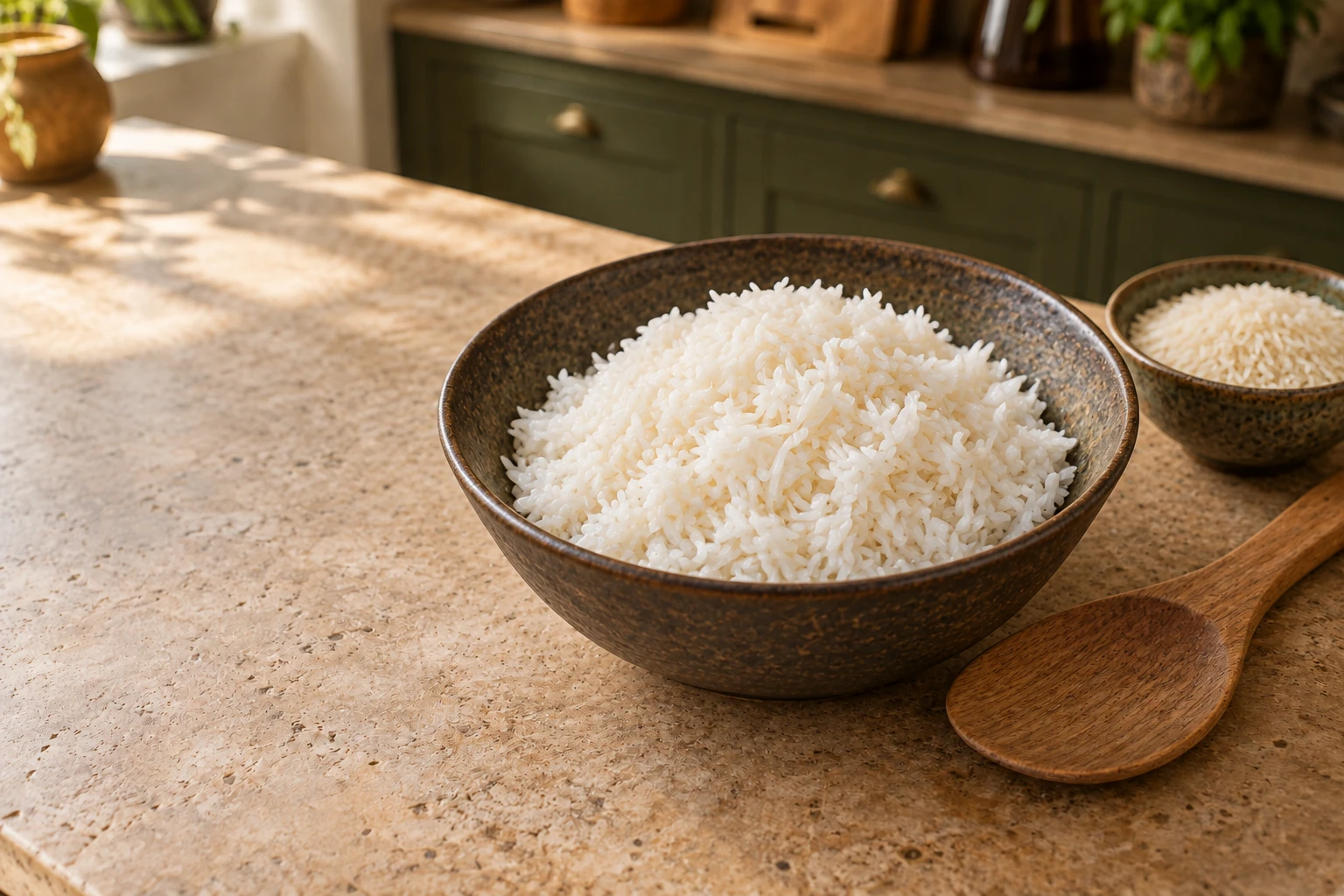
Good rice starts before the water boils.
Choose rice to suit the dish. Measure the water, leave the lid alone and allow a short rest. Get control of both saucepan and rice cooker.
AI-generated illustration.
Jasmine and basmati do different jobs.
For our red curry we choose jasmine rice: aromatic, soft and slightly cohesive. Basmati tends to be drier and more separate. Slightly sticky jasmine rice is therefore not necessarily a failure; the goal is tender grains, not porridge. About jasmine rice: Tilda ↗
| Rice type | Texture | Works well with |
|---|---|---|
| Jasmine rice | Soft and slightly sticky | Thai curry and Southeast Asian dishes |
| Basmati | Longer, more separate grains | Indian dishes, pilaf and biryani |
| Parboiled / easy cook | Firmer and less prone to overcooking | Side dishes and rice salads |
| Sushi rice | Holds together when cooked | Sushi and rice bowls |
| Arborio / carnaroli | Produces a creamy cooking liquid | Risotto |
| Brown rice | More bite and longer cooking time | Side dishes when you want firmer grains |
Rice descriptions are based on The Rice Association. Sushi rice and the sticky rice used for mango sticky rice are different ingredients; buy the type your recipe specifies.
Three things easily confused.
Dry rice and cooked rice
The quantities in our recipes refer to dry rice. Allow around 60–75 g per person as a side, adjusting for appetite and the rest of the meal. The curry recipe uses 70 g per person.
Grams and decilitres
One decilitre of rice does not weigh 100 grams. A water ratio given by volume therefore cannot be copied as the same ratio by weight. Use a recipe with clear units, or the same measuring cup for both when the ratio is by volume.
Saucepan and rice cooker
They retain steam differently. A water quantity that works in one saucepan is not automatically right for a rice cooker. Rice type, age and any soaking also matter. Start with the package or appliance instructions.
Rinsing and soaking
Rinsing removes loose surface starch. Soaking lets the grain absorb water before cooking. These are separate steps. This saucepan method uses rinsed, drained white jasmine rice without soaking.
Jasmine rice in a saucepan.
240 g dry Tilda jasmine rice + 480 ml water. This follows the producer’s ratio, scaled to four portions. For another brand, use that pack’s water quantity and cooking time. The ratio here compares grams of rice with millilitres of water, not ‘two cups of water per cup of rice’.
Rinse and drain
Gently rinse the rice in cold water until the water is considerably clearer. Drain thoroughly.
Measure and heat
Put the rice and measured water in a saucepan with a tight-fitting lid. Bring gently to the boil, stir once and put the lid on.
Leave it to simmer
Turn down to low heat and cook for about 12 minutes, as directed by Tilda. Leave the lid in place and avoid stirring.
Resting is the final cooking stage
Remove the pan from the heat. Leave covered for 3–5 minutes before gently fluffing with a fork or rice paddle.
The method follows Tilda’s instructions for a covered saucepan. Adapt water quantity and timing to your product.
Jasmine rice in a rice cooker.
Use the supplied measuring cup
Measure dry rice with the cooker’s own cup when using the markings in the inner pot. A random coffee cup may give a very different quantity.
Rinse, then measure water with the rice in the pot
Rinse and drain unless the pack specifies no-rinse rice. Put it in the inner pot. Fill with water to the mark for the correct number of cups and rice type, following the manual. The mark indicates the water level with the rice in the pot, not a separate volume of water.
Select the right programme
Use ‘Jasmine’ if available; otherwise follow the manual’s setting for white long-grain rice. Do not use the brown-rice programme for white jasmine rice.
Fluff when finished
Follow the appliance’s directions for resting and programme completion. Then turn gently with the rice paddle. If the manual gives specific water measurements for jasmine rice, these take precedence over a general recipe.
The measuring-cup and water-line principles are described by Zojirushi. Always check your own model’s manual.
When the rice is not as expected.
Soft and mushy
Common causes are too much water, excessive cooking or a lot of stirring. You cannot uncook it. Measure carefully next time and change only one thing, such as slightly less water if the grains were fully tender.
Hard centre, dry pan
There may be too little water or too much steam loss. Try a few tablespoons of boiling water, replace the lid and give it a few minutes over low heat before resting again. Check that the lid fits properly.
Water remains but the rice is hard
It usually needs more time or heat. Continue gently with the lid on. Do not drain just because the timer rings; test a grain.
Burnt at the bottom
The hob may have been too hot or the pan too thin. Lift the good rice into another bowl without scraping up the burnt layer. Use lower heat or a heavier-bottomed pan next time.
These are practical troubleshooting tips. Note the rice quantity, water and method when you get a result you like; the next dinner will be easier.
Look after the rice straight away.
Cool leftover cooked rice quickly and refrigerate. Divide into smaller, shallow containers. Do not leave the saucepan on the worktop until the next day.
Mattilsynet explains that bacteria can produce heat-stable toxins in rice left at room temperature. Reheating therefore does not make improperly stored rice safe again, and smell or taste is not a reliable test. Read Mattilsynet’s advice ↗
Sources and further reading
Source research is AI-assisted. Practical suggestions and flavour assessments are Sapidus’ applications of the source material.