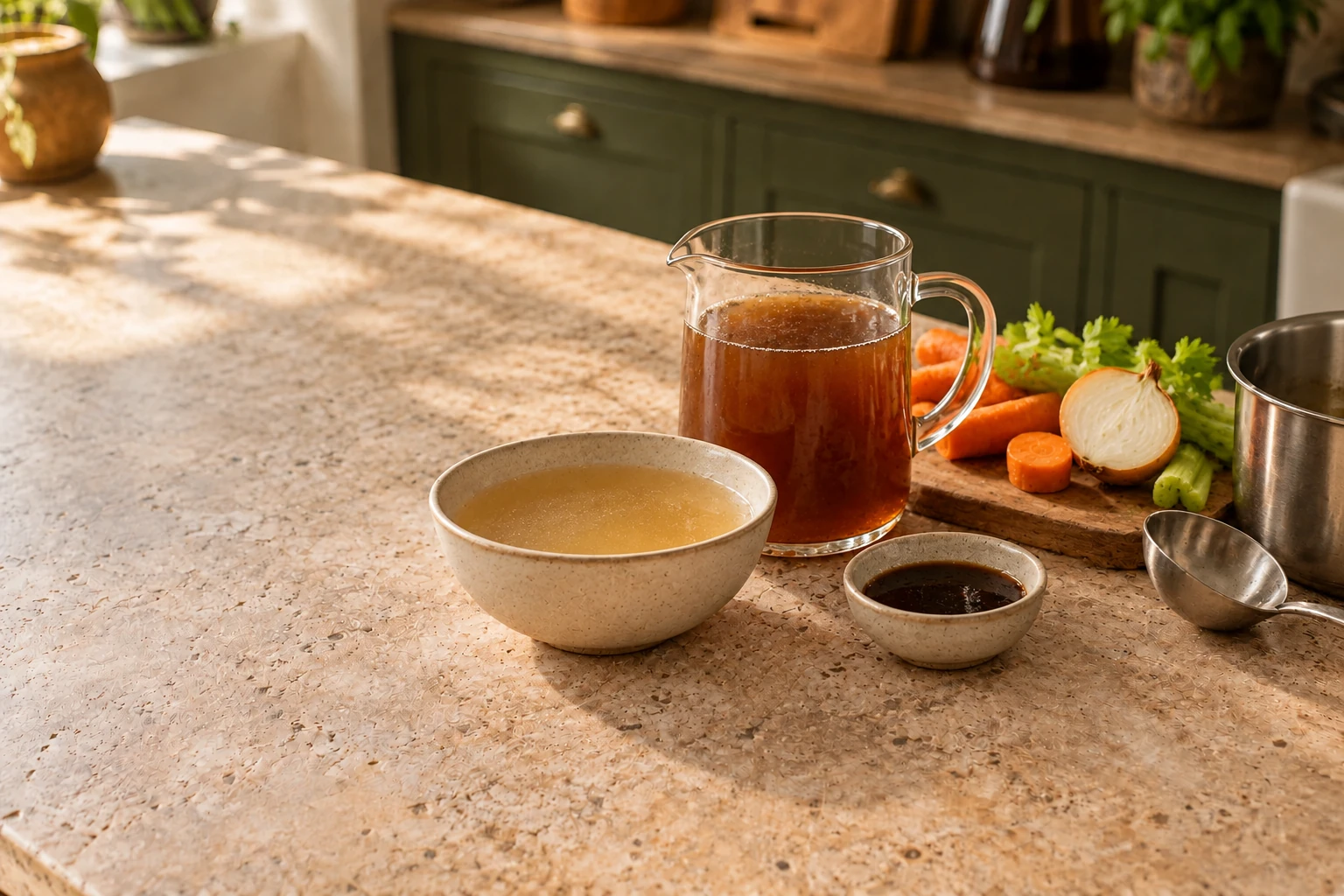
More depth in your food. Salt under control.
Half a litre of stock is not the same as half a litre of stock concentrate. Here we separate quantity, flavour and salt, so you can build a good sauce while keeping control of the pot.
AI-generated illustration.
Ready-to-use liquid or something to dilute?
Stock is extracted from meat, bones, fish, shellfish or vegetables and strained. Shops sell both ready-to-use stock and concentrated products. Names are used somewhat differently, so the label determines how to measure your particular product.
| Product | What you often get | Check before use |
|---|---|---|
| Ready-to-use stock | A liquid that can form the base of a soup or sauce. | Whether it is ready to use, concentrated or already salted. |
| Liquid stock concentrate / fond | Flavour concentrate usually diluted with water. | Dosage, salt content and what the producer counts as the prepared liquid. |
| Bouillon cube, powder or gel | A concentrated product dissolved in liquid. | How much water each dose requires and the salt content of the prepared mixture. |
| Homemade reduced stock | Stock with water evaporated, concentrating its flavour. | How far it has been reduced and whether it was salted before reduction. |
Dark colour or thick consistency alone does not tell you how strong or salty a product is. Setting to a jelly in the fridge does not tell you everything about its flavour either.
Choose stock for the dish.
Brown beef stock
A good starting point for dark sauces and meat stews. Roasting bones and vegetables produces a different flavour from a light stock. Suitable for Bœuf Sans Vin and Norwegian beef stew.
Chicken stock
A versatile base for chicken soup, vegetable dishes and curry. Choose a strength that gives coconut milk and spices room to come through.
Fish stock
Use when fish flavour should carry the dish, as in our fish soup. Fish stock should not receive the same long simmering as stock made from large beef bones.
Vegetable stock
Good for tomato soup and vegetable dishes. Check whether a particular vegetable or herb dominates before using a lot in a mild dish.
Read the label before doubling.
Find the recipe’s liquid quantity
If it says ‘5 dl stock’, the starting point is 5 dl ready-to-use stock or prepared bouillon. It does not mean 5 dl concentrate.
Follow your particular product
As a calculation example only: if the label says 10 ml concentrate per 5 dl water, 1 litre of water needs 20 ml of that product. This is an example, not a universal dosage for stock concentrate.
Taste the base
Assess salt and flavour before adding it to the dish. Consider a weaker mixture or unsalted stock if the sauce will be reduced substantially.
Hold back other salty ingredients
Soy sauce, fish sauce, parmesan, bacon and Worcestershire sauce can also contribute salt. Taste everything together before the final seasoning.
If a curry already has the right amount of sauce, extra ordinary stock can make it too thin. Use a concentration suited to the recipe and adjust carefully. Do not automatically replace concentrate with twice the volume of liquid.
Reduction concentrates both flavour and salt.
Water evaporates during reduction. Unsalted stock can become fuller, while salted bouillon also becomes saltier. It is therefore easier to reduce a lightly salted base and adjust the salt afterwards.
If one litre of liquid is reduced to half a litre, the salt from the original litre remains in a smaller volume. Taste as you go. Diluting an overly salty sauce and then boiling away that same water again does not solve the problem.
Too salty
Stop reducing. Mix with unsalted stock or more of the dish’s unsalted main base. Adjust the consistency without concentrating everything back to where you started.
Too weak
First consider whether it simply needs a little salt or whether the stock flavour itself is weak. Reduction works best when the salt level allows it. Otherwise a careful addition of an appropriate concentrate may be more useful.
Jelly when cold, thin when hot
Gelatin-rich stock can set when cold and become liquid again when heated. Judge the sauce at serving temperature, not just straight from the fridge.
Wrong flavour in the dish
A stock product with strong herbs or smoky notes can change the whole dish. A milder base is often easier to build on.
Small containers, clear labels.
Cool homemade stock quickly in smaller containers, ideally using an ice-water bath. Mattilsynet advises cooling from 60 to 10 °C as quickly as possible and within two hours at the latest. Then refrigerate, or freeze after cooling.
Label portions with the date, main ingredient, whether the stock is salted and whether it is reduced. Follow the after-opening instructions for bought products. Do not assume an opened bottle of concentrate keeps as long as an unopened one.
Not sure what the dish needs? Try the flavour balance guide →
Sources and further reading
Source research is AI-assisted. Kitchen examples, proposed tests and troubleshooting are Sapidus’ practical applications of the source material.