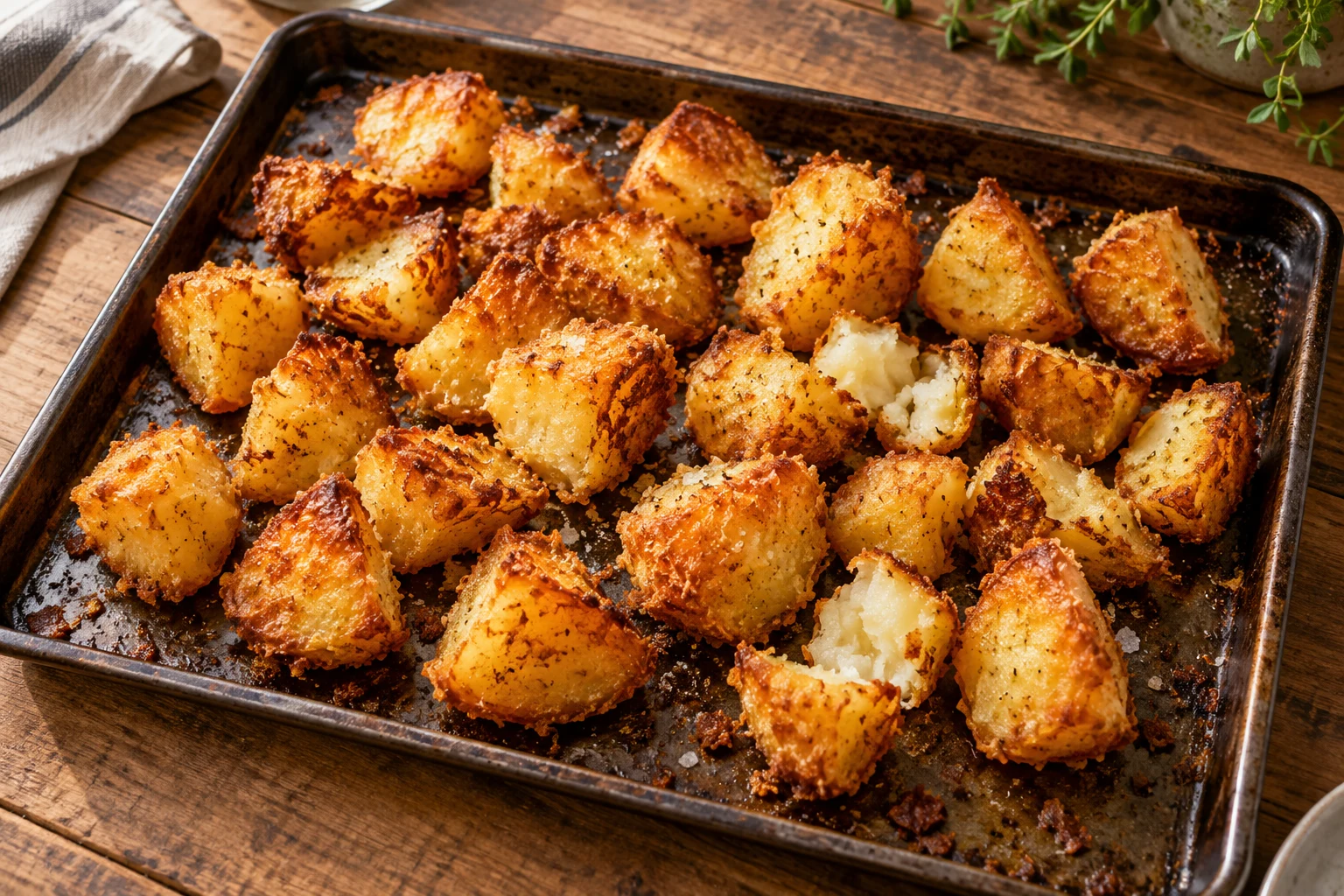
Extra-crisp roast potatoes with bicarbonate of soda
Parboil potatoes with a little bicarbonate of soda, steam-dry them and shake to roughen their surfaces. In the oven, the outer layer becomes a golden crust around a soft centre.
Jump to the recipe ↓AI-generated illustration.
Optional: keep the screen awake while following the recipe. Uses more battery.
All recipes start at 4 people, as a side dish.
Ingredients now shown for 4 people as a side dish.
Cuisine: International
Estimated timing: about 15 min preparation · about 55 min cooking · about 5 min resting. These estimates describe the basic method and are not measured kitchen timings. Follow the method and any time ranges above.
Method
Heat the oven and cut the potatoes
Set the oven to 230 °C conventional, or 200 °C fan. Peel the potatoes and cut into even pieces about 4–5 cm across. Small pieces break up more easily during parboiling.
Measure water, bicarbonate of soda and salt
Measure enough water into a roomy saucepan to cover the potatoes generously. Add ¼ level tsp bicarbonate of soda and 8 g fine salt per litre. Bring to the boil and carefully add the potatoes. The bicarbonate amount depends on litres of water and therefore does not automatically scale with the number of people.
Parboil gently
Simmer for about 8–12 minutes from when the water returns to a simmer. The edges should soften and begin to crumble, while a knife meets some resistance in the centre. Start checking after 6–8 minutes, particularly with floury potatoes. Stop before the pieces fall apart.
Steam-dry and roughen
Drain into a colander and let the potatoes steam-dry for 3–5 minutes. Transfer to a roomy bowl with the olive oil. Put on the lid and shake gently a few times, or turn with a large spoon, until a thin, rough layer forms on the surface. Do not shake them into mash.
Roast with plenty of space
Spread in a single layer on a roomy baking tray, leaving space between pieces. Roast for 20 minutes without moving them. Turn carefully and roast for another 20–30 minutes. Add pepper and any dried herbs for the last 10 minutes. The potatoes should be golden and crisp outside and completely tender inside.
Season and serve immediately
Taste a potato before adding any fine salt. Serve immediately and avoid a lid or tightly wrapped foil, which softens the crust.
Get to know the spices in this dish
About this version
Home-tested in the Sapidus kitchen. Quantities are for a side dish; times are approximate, so check tenderness and browning.
Good to know before you cook
What does bicarbonate of soda do?
It makes the cooking water more alkaline and helps break down the outer potato layer. Roughening this layer and drying it in the oven creates more surface that can become crisp. A little is enough; too much can cause an off-flavour and make the potatoes disintegrate.
Let the potato determine parboiling time
Variety, storage and piece size affect timing. Look for soft, crumbling edges and a centre that still holds the piece together. Mandelpotet can break up quickly; Kerrs Pink or a moderately floury potato is easier to handle.
Do not crowd the tray
For a large batch, use several trays and swap their positions in a fan oven. Space and dry surfaces are crucial for the crust.
How this differs from ordinary wedges
Ordinary roast wedges go into the oven raw. Here, parboiling, bicarbonate of soda and gentle shaking create a more uneven surface and a more substantial crust. The method takes a little more work, but suits extra-crisp potatoes.
Sources and further reading
Sources were compiled with AI assistance.