Sapidus Pizza Master Dough – 48H
Long-fermented pizza dough with Caputo Nuvola, Caputo Cuoco and Manitoba Oro. Autolyse, about 70% hydration and separate water for the yeast and salt give a detailed method for pizza night.
Jump to the recipe ↓AI-generated illustration.
Optional: keep the screen awake while following the recipe. Uses more battery.
The original recipe makes 10 pizzas. Choose a quantity to scale the ingredients.
Ingredients now shown for 10 pizzas.
Cuisine: Italian-inspired
Method
Weigh the flour and divide the water
Mix all three flours. Weigh the water into three separate portions as listed: autolyse water, yeast water and salt water. All of this water is included in the total; do not add extra water to dissolve the salt or yeast.
Autolyse – 20 minutes
Mix the flour with the autolyse water until all flour is moistened. The dough need not be smooth yet. Cover and rest for 20 minutes without yeast or salt.
Prepare the yeast water and salt mixture separately
Dissolve the fresh yeast in the yeast water. In a separate container, stir the salt into the salt water. The salt need not dissolve completely in this small amount of water: include every crystal when kneading the mixture into the dough. Do not mix the concentrated salt mixture directly with the yeast water.
Knead in the yeast, then the salt water
Work the yeast water into the dough first. Then gradually add the salt water while kneading. Continue until smooth and elastic, about 10–15 minutes depending on the mixer and speed. Aim for a finished dough temperature of 23–25°C. Avoid overheating.
First rise – about 2 hours
Cover and rest at normal room temperature, around 20–22°C, for about two hours. Fold gently once or twice during the first hour if the dough needs more strength. Follow its development; a warm kitchen speeds up the rise.
Shape balls and refrigerate
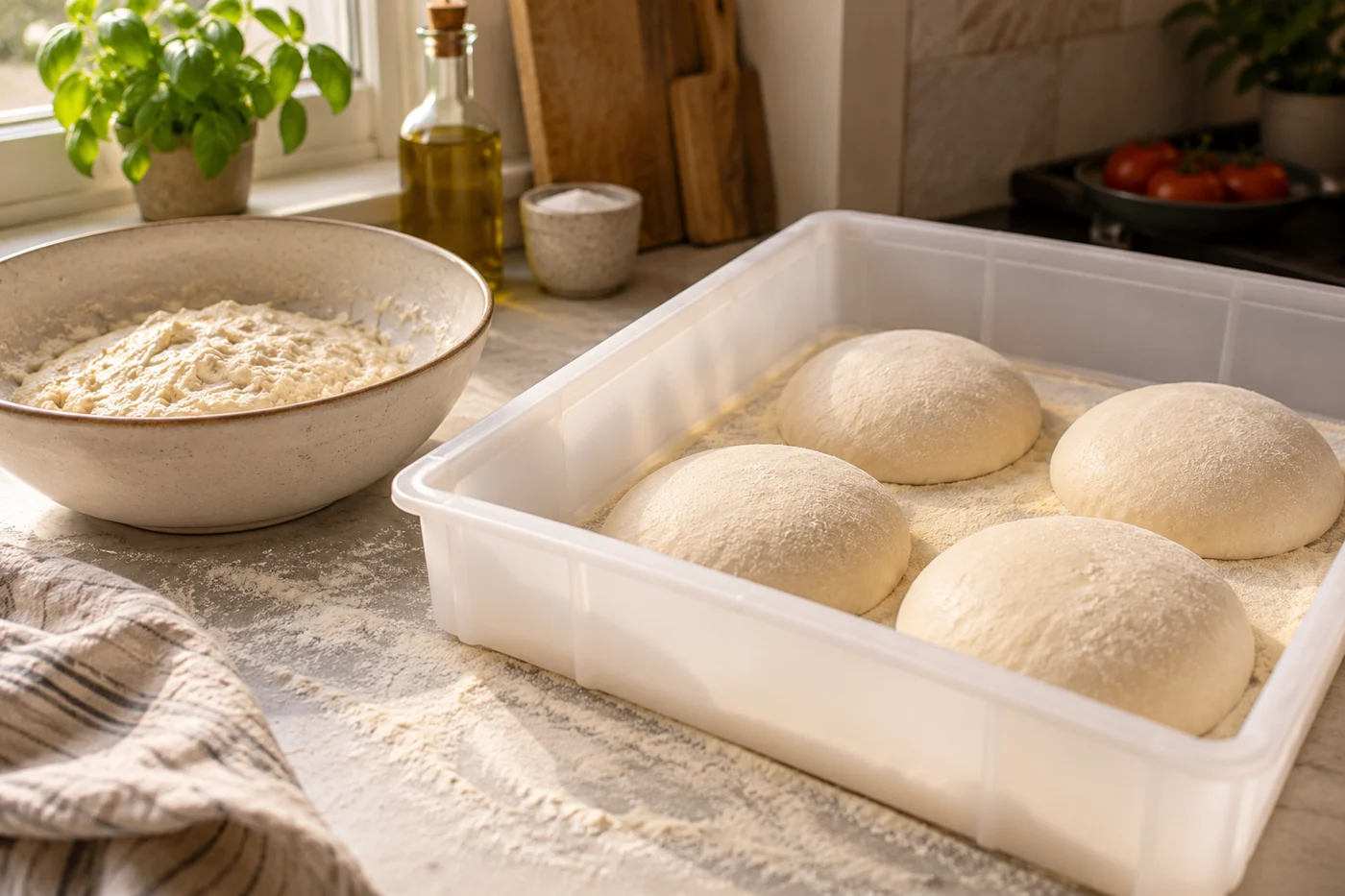
Divide into equal pieces of about 300 g, one for each selected pizza. Shape smooth balls, seam-side down, and place in covered food containers with room to rise. Refrigerate at around 4°C for about 46 hours.
Bring to room temperature before baking
Take the dough out about 2 hours 50 minutes before baking. Keep the containers covered. The dough should be soft, airy and easy to stretch; adjust the time to the room temperature.
Preheat the oven and pizza steel
Preheat the steel for 45–60 minutes at 250–300°C. Start with conventional top and bottom heat and use equipment rated for the temperature.
Shape, top and bake
Press from the centre outwards, preserving air in the rim. Stretch gently, add a thin layer of sauce and light toppings. Bake for about 5–8 minutes, depending on the oven. If needed, finish briefly under the grill and watch closely. Bake one pizza at a time.
Example: first pizza in the oven Saturday at 19:00
Thursday 15:30: mix flour and autolyse water. 15:35–15:55: autolyse. 15:55–16:10: add yeast and salt water, then knead. 16:10–18:10: first rise. 18:10: shape balls and refrigerate. Saturday 16:10: take the dough out. 18:00–18:15: start preheating. 19:00: shape and bake. This gives 46 hours in the fridge and 2 hours 50 minutes at room temperature; about 51½ hours in total from mixing.
About this version
Version 1.0. Published as home-tested following the user’s confirmation. Images are AI-generated illustrations.
Good to know before you cook
Original batch and baker’s percentages
The original makes about 2,998 g of dough: ten balls of approximately 300 g. Total flour: 1,732 g, split into 691 g Nuvola, 691 g Cuoco and 350 g Manitoba Oro (about 40/40/20%). Water: 1,212 g, about 70%. Salt: 52 g, about 3% of flour weight. Fresh yeast: 2 g, about 0.12%.
Water distribution and scaling
For ten pizzas, divide the total water into 1,112 g for autolyse, 20 g for yeast and 80 g for salt. Select the pizza count to scale all three portions together. Keep each ball at about 300 g; weigh the small yeast quantity precisely. Salt stays at about 3% when scaling this dough.
What 48H means
“48H” names about two hours of first rise plus 46 hours of cold proof. Including 2 hours 50 minutes of warming, total proving is 50 hours 50 minutes. Mixing, autolyse and kneading add 40 minutes: start to first bake is 51 hours 30 minutes. The calculator’s time buttons instead describe total proving including warming.