The right cheese. A better dinner.
Cheese can provide a crisp crust, long strings, a velvety sauce or the entire meal. Choose it for its role in the dish – from everyday gratins to fondue, raclette and small Norwegian dairies among fjords and mountains.
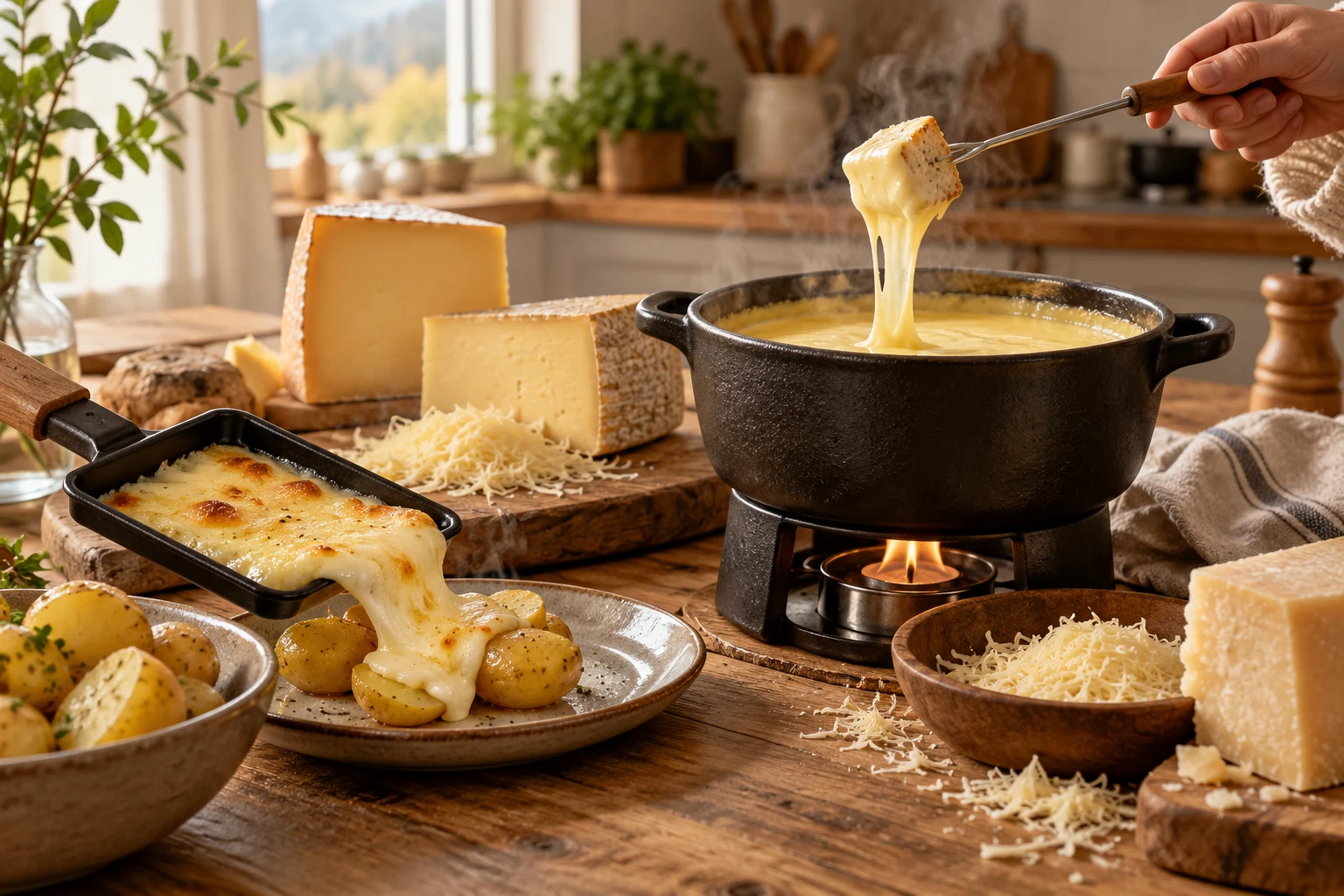
AI-generated illustration.
Do you want flavour, stretch or a smooth sauce?
No cheese is best for everything. Mozzarella stretches, Parmesan provides concentrated flavour, and raclette becomes soft and flowing. Two cheeses together are often more useful than one doing the whole job.
| What you are making | A good starting point | Getting the most from the cheese |
|---|---|---|
| Pizza | Low-moisture mozzarella; a little Parmesan for flavour | Good melting and stretch. Drain fresh mozzarella so the base does not become wet. |
| Lasagne and potato gratin | Gruyère, Gouda or a semi-hard Norwegian cheese + a little Parmesan | A melting main cheese provides coverage; a smaller proportion of aged hard cheese adds flavour. |
| Cheese sauce and macaroni cheese | Medium-mature Cheddar, Gouda or Gruyère | Melt into the finished sauce over low heat. Very old cheese is best used for flavour in a blend. |
| Burger | Cheddar or processed burger cheese | Cheddar gives a distinct cheese flavour. Processed cheese gives a smoother, softer covering. |
| Fondue | Gruyère + Vacherin Fribourgeois, or Gruyère + Emmentaler | Choose cheeses suited to fondue. Liquid, a little acid and starch help the mixture stay together. |
| Raclette | Raclette cheese | Melt slices and pour over potatoes and vegetables. Do not leave it until the fat separates. |
| Risotto and pasta | Parmigiano Reggiano, Grana Padano or Pecorino | Grate finely and stir in towards the end, preferably off the heat. Pecorino is often saltier and sharper. |
| Steak sauce, mushrooms and gnocchi | Gorgonzola, Kraftkar or another blue cheese | Start with a little and taste before salting. The cheese should lift the dish, not overwhelm everything. |
| Fillings for pasta and baked dishes | Ricotta or cream cheese; mozzarella for stretch | Ricotta makes a soft filling and holds its shape better. Cream cheese adds body and tang. |
| Roasted vegetables | Feta or chèvre | Softens and colours, but does not make the same flowing cheese layer as raclette. |
| Barbecue and frying pan | Halloumi or cheese labelled for grilling | Holds its shape and develops a crust. This is a different task from making cheese sauce. |
| Game and cream sauces | A small piece of brunost | Adds sweetness and caramel notes. Use as a seasoning, not as the main cheese in fondue. |
Try about three parts supple, semi-hard cheese to one part finely grated Parmesan or another mature flavourful cheese. This is a test suggestion, not a rule: salt, strength and maturity vary. Compare with your usual cheese.
Different cheeses do different jobs.
| Cheese / family | Flavour and properties | Cooking uses | Remember |
|---|---|---|---|
| Mozzarella | Mild, elastic and stretchy | Pizza, lasagne and filled baking | Fresh mozzarella in brine behaves differently from drier pizza mozzarella. |
| Gouda / semi-hard Norwegian white cheese | Mild to nutty; usually melts well | Gratins, hot cheese toasties and sauces | Young and medium-mature cheese gives a different result from very old, dry cheese. |
| Cheddar | Full-flavoured and tangy, from mild to strong | Burgers, macaroni cheese and sauces | Extra-mature cheese can release fat; use moderate heat and preferably a sauce base. |
| Gruyère / Comté / Emmentaler | Nutty flavour and good melting | Fondue, gratins, onion soup and quiche | These are different cheeses but can fill similar roles. Flavour and maturity determine substitutions. |
| Raclette / Fontina | Smooth melting and full flavour | Raclette, potato dishes and hot cheese fillings | Raclette cheese is the first choice when the melted cheese itself is the main dish. |
| Parmesan / Grana Padano / Pecorino | Dry, concentrated and salty | Pasta, risotto and flavour in sauces and gratins | Provides flavour rather than long cheese strings. Grate finely and allow enough liquid in sauces. |
| Blue cheese | From mild and creamy to sharp and salty | Sauces, pasta, mushrooms and small amounts on pizza | Taste before adding more. A strong cheese often needs only a small role in the dish. |
| Brie / Camembert / soft washed-rind cheese | Creamy when ripe; melts within the rind | Baked cheese, tarts and fillings | Maturity matters. Use a small ovenproof dish for baking. |
| Ricotta / cream cheese / mascarpone | Soft, fresh or creamy | Fillings, creamy sauces and finishing | Not the same stretch as mozzarella. Mascarpone makes particularly rich sauces. |
| Feta / chèvre | Tangy and often salty | Baked vegetables, tarts and fillings | Softens but does not automatically become a smooth, flowing cheese sauce. |
| Halloumi | Firm, salty and chewy | Barbecue, frying pan and warm salads | Retains its shape. Dry the surface and fry until coloured. |
| Processed cheese | Even consistency; flavour varies by product | Burgers, cheese dips and simple sauces | A distinct processed cheese type containing emulsifying salts. Read the ingredients and instructions. |
Melted cheese is not always cheese sauce.
When cheese heats, fat softens and the protein structure changes. Water content, acidity, maturity and cooking affect the result. Some cheeses flow, some stretch and others retain their shape. More heat is not always the answer.
A smooth sauce needs fat and liquid to stay together. Grate the cheese, finish the sauce base first and lower the heat before stirring in a little cheese at a time. Cook a flour-thickened base fully before adding cheese. Avoid prolonged, vigorous boiling afterwards.
Processed cheese is a separate product type
Processed cheese is made by processing cheese with ingredients including water and emulsifying salts. These help fat, water and proteins form an even mixture. A processed burger cheese can therefore provide a smooth covering that regular Cheddar does not always produce. Raclette that melts beautifully is not, for that reason, processed cheese.
Cream cheese is not automatically processed cheese either. Check the ingredients and intended use. Choose Cheddar for its flavour, processed cheese when an even consistency suits the dish, or combine them in a sauce you want to experiment with.
Grate it yourself when consistency matters
You then know which cheese and maturity you are using. Pre-grated cheese may contain anti-caking agents that affect the sauce; other packets contain only cheese. Read the packet. For pizza and gratin, pre-grated cheese is often perfectly practical.
Fondue: the cheese becomes the meal.
Cheese fondue combines grated cheese and liquid into a mixture for dipping bread. Classic moitié-moitié uses equal parts Gruyère and Vacherin Fribourgeois. Gruyère and Emmentaler are another good starting point. Vacherin Fribourgeois is not the same cheese as Vacherin Mont d’Or.
800 g cheese, about 3.5 dl dry white wine, 1 garlic clove and 3 level tsp cornflour (cornstarch). Try 400 g Gruyère and 400 g Vacherin Fribourgeois. A little lemon juice can adjust acidity; nutmeg and pepper are optional. This is a guide to a kitchen variation – follow a specific fondue recipe if you make substantial cheese substitutions.
- Grate or finely slice the cheese. Rub a heavy-based pot with a halved garlic clove.
- Mix the cheese with the cornflour. Heat the wine gently and add the cheese a little at a time, stirring.
- Let the cheese melt into a smooth, cohesive mixture. Control the heat and avoid leaving it at a rolling boil.
- Adjust with a little warm liquid if too thick. Taste before adding salt.
- Keep warm over low heat in a suitable fondue pot. Continue stirring during the meal, especially along the bottom.
Serve with bread firm enough for dipping, boiled baby potatoes, lightly cooked vegetables, pickled gherkins and a fresh salad. Allow about 150–200 g cheese per adult as a main course, depending on the accompaniments.
Without wine?
Alcohol-free apple juice is an alternative recommended by the Swiss cheese organisation, but adds more sweetness. Mild vegetable stock with a little lemon is another kitchen variation; begin with less liquid and adjust. Flavour and stability will differ from wine. Brief heating does not guarantee that wine-based fondue is alcohol-free.
Raclette need not require a major equipment project.
Raclette names both a cheese type and a meal of melted cheese served over foods including potatoes. Traditionally, a cut surface is heated and the cheese scraped off. At home, small pans in a raclette grill are practical.
- Boil small waxy potatoes. Prepare mushrooms, onions, broccoli or other vegetables.
- Place slices of raclette cheese in the pans. Heat until flowing and perhaps lightly golden on top.
- Pour over hot potatoes and vegetables. Serve with pickled gherkins, pickled onions and, if you like, salad.
About 150–200 g cheese per adult is a useful starting point. Without a raclette grill, use a small ovenproof dish under the oven grill and watch closely. Thin cheese slices over hot potatoes in individual dishes also work.
Gruyère, Fontina or a suitable semi-hard Norwegian cheese can make a good hot potato dish, but the flavour and flow differ. Raclette cheese is the simplest first choice. Remove wax and packaging; judge natural rind according to the product instructions and your taste.
Look beyond the standard block.
Small Norwegian dairies make cheeses that deserve a place at dinner. You need not grate an expensive cheese over everything: use a smaller amount where you will notice it. In a mild gratin, one distinctive cheese can transform the dish.
| Cheese | Dairy and location | What type of cheese? | Sapidus’ suggested cooking uses |
|---|---|---|---|
| Kvit Undredal | Undredal Stølsysteri · by Aurlandsfjorden | Semi-hard white goat’s cheese in several maturities | Try medium-mature cheese in potato gratin or a tart. Use small amounts of well-aged cheese over pasta for flavour. Goat’s milk gives a different result from cow’s milk cheese. |
| Fanaost | Ostegården · by Fanafjorden | Semi-hard Gouda-style cheese | Try in gratin or on onion soup. Choose maturity for the strength you want; an older cheese can be blended with a milder, well-melting white cheese. |
| Fjelldronning | Avdem Gardsysteri · Lesja | Aged, washed-rind cheese made from raw cow’s milk | Try a smaller proportion in a potato dish or warm cheese blend. Taste the cheese and rind first; the aroma can be pronounced. |
| Kraftkar | Tingvollost · Torjulvågen, Nordmøre | Rich cow’s milk blue cheese with extra cream | Stir a little into a warm cream sauce for steak, mushrooms or gnocchi. Start cautiously and taste before adding salt. |
| Nidelven Blå / Edel Blå | Gangstad Gårdsysteri · Inderøy | Nidelven is strong; Edel Blå is a milder choice | Try in a sauce or with mushrooms. Choose Edel Blå for a gentler blue cheese character. |
| Granstubben | Gangstad Gårdsysteri · Inderøy | Soft washed-rind cheese wrapped in spruce bark | Made for heating in the oven. Follow the manufacturer’s instructions, use an ovenproof dish and serve with bread or potatoes. Do not eat the bark. |
| Camembert in a ceramic bowl | Gangstad Gårdsysteri · Inderøy | White-mould cheese prepared for baking | A simple Norwegian alternative for baked Camembert. Follow the product’s cooking instructions. |
Cheese types and producer details come from the sources below. Cooking uses are our suggestions, not a claim that every combination has been tested. Melting properties vary with maturity and batch. Ask the cheese counter or dairy which variety they recommend for hot dishes.
Ask this at the cheese counter
“I am making potato gratin – which local cheese melts smoothly, and how strong is it?” is more useful than simply “which cheese is best?”. Describe the dish and ask about maturity, rind and suitable quantity. Farm shops and specialist shops may carry different varieties from supermarkets.
When the cheese will not cooperate.
The sauce turns grainy or splits
Take the pan off the heat. Gently whisk in a little warm milk or another suitable liquid. This may help, but a badly split sauce will not always become smooth again. Next time, use lower heat, smaller additions of cheese and a stable sauce base.
Fondue becomes a lump surrounded by fat
Move the pot to the hob for control. Mix a little cornflour with a splash of cold wine or another recipe liquid, add it and heat gently while stirring vigorously. A little lemon can help. Do not pour dry starch straight into the pot.
A puddle forms on the pizza
Fresh mozzarella and wet toppings release liquid. Drain the cheese well, tear it into smaller pieces or use drier pizza mozzarella. Limit the amount and consider removing moisture from mushrooms and vegetables before topping.
The gratin becomes oily or dark
Too much cheese, very mature cheese or prolonged high heat can cause fat separation and a dark crust. Use a supple main cheese, and consider adding it later when the dish needs a long baking time.
The cheese refuses to flow
Do not expect feta, ricotta and halloumi to behave like raclette. Match the cheese to the task. More heat may simply dry them out or scorch the surface.
The cheese overwhelms the meal
Blue cheese, goat’s cheese and strong washed-rind cheese can dominate. Start with a smaller proportion and blend with a milder cheese. Add salt only after the cheese has melted in.
Substitute by properties, not just colour.
Gruyère can often be replaced with Comté or a suitable semi-hard cheese when melting and nutty flavour are the aim. Grana Padano can sometimes replace Parmesan; Pecorino often needs a smaller quantity because salt and strength differ. Mozzarella and ricotta, however, are not equivalent substitutes in a filling.
Store cheese cool and wrapped according to the manufacturer’s advice. Small leftovers of hard cheeses can be grated and frozen in portions for cooking; the texture may change. Use the oldest leftovers first and label the bag with the cheese type. Wax, plastic and other inedible coatings must not go into the pot.
A clean, edible Parmesan rind can simmer in soup or ragù and be removed before serving. Small amounts of brunost can go into game or cream sauces, but add sweetness and cannot replace white goat’s cheese. Kvit Undredal and brown goat’s cheese are very different ingredients.
Replace some of your usual gratin cheese with Fanaost or Kvit Undredal, or stir a little Kraftkar into a familiar sauce. You will notice what the cheese contributes without changing the whole meal at once.
Sources and further reading
Source research is AI-assisted. Kitchen examples, proposed tests and troubleshooting are Sapidus’ practical applications of the source material.
- Undredal Stølsysteri – cheeses and maturities ↗
- Ostegården – mature Fanaost ↗
- Avdem Gardsysteri – products ↗
- Ostelandet Norge – Fjelldronning ↗
- Tingvollost – Kraftkar ↗
- Gangstad Gårdsysteri – cheese types and oven cheeses ↗
- Cheeses from Switzerland – fondue blends and preparation ↗
- Le Gruyère AOP – fondue moitié-moitié ↗
- Raclette Suisse – raclette cheese ↗
- Melk.no – processed cheese explained ↗
- Serious Eats – stable cheese sauce with starch ↗