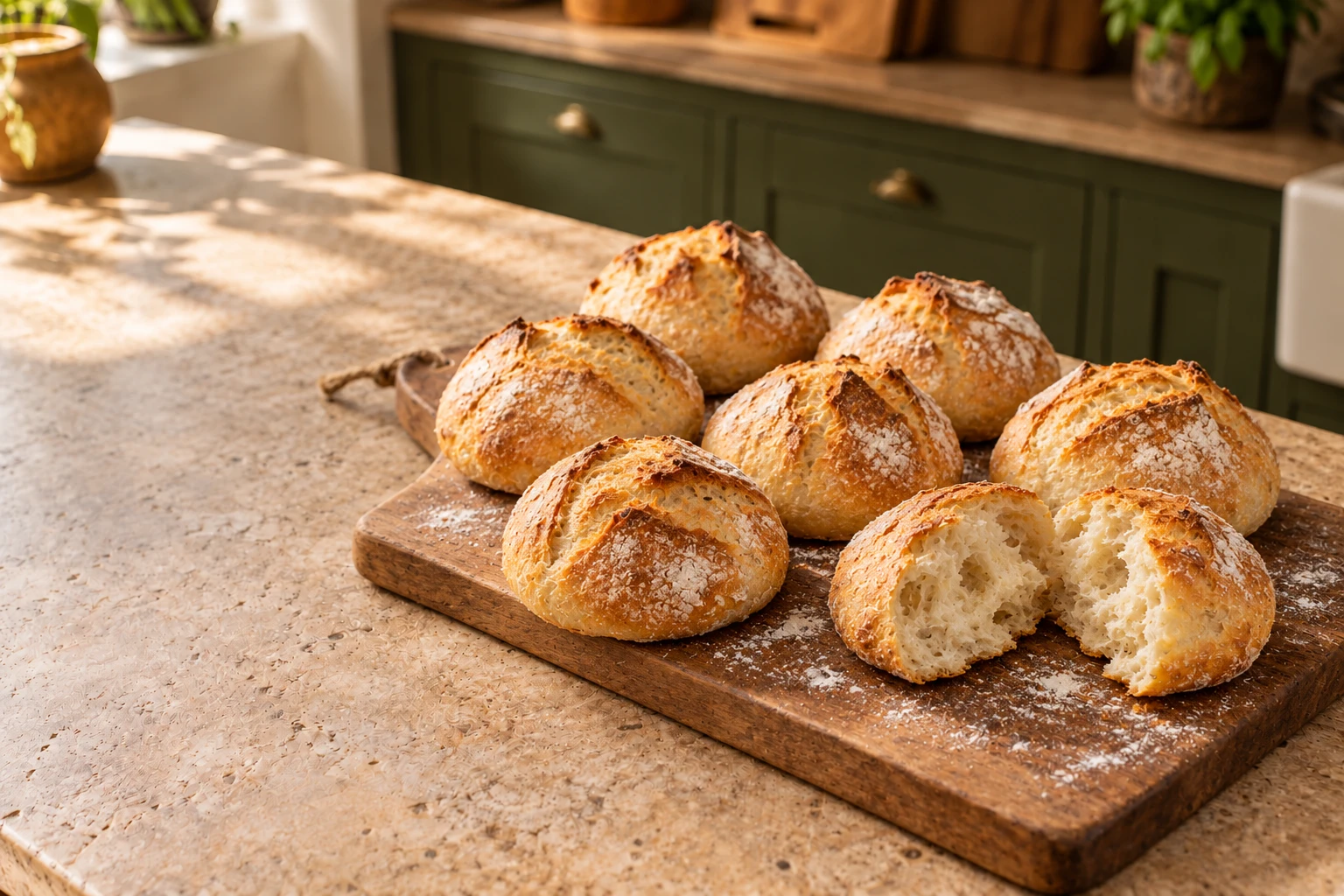
Moist sourdough rolls
A simple dough of wheat flour, water, salt and active sourdough starter. Small rolls with a crisp crust and a moist, irregular crumb.
Jump to the recipe ↓AI-generated illustration.
Optional: keep the screen awake while following the recipe. Uses more battery.
All recipes start at 4 people, as a side dish.
Ingredients now shown for 4 people as a side dish.
Cuisine: International
Method
Use an active starter
Begin when the starter is visibly airy and has risen well after feeding. A cold, sluggish starter straight from the fridge will not give the same predictable rise.
Rest flour and water
Mix flour and water until all flour is moistened. Cover and rest for 20–30 minutes. Then work in starter and salt.
Fold and rise
Make 2–3 gentle sets of stretches and folds early in fermentation, resting between them. Then leave until visibly airy, with bubbles around the edge and about half as much volume again. This may take several hours; do not rely on the old short clock time.
Divide and prove
Turn onto a lightly floured worktop and divide into 8–10 pieces for the original dough. Shape gently and place on baking paper with some space between. Cover and prove until the pieces feel airy and a gentle finger indentation slowly partly springs back.
Bake until golden
Preheat the oven thoroughly to 230 °C conventional. Bake for about 15–18 minutes, or until well browned and cooked through. Size determines timing. Cool on a rack before splitting.
About this version
The rolls are retained as a separate recipe; the sourdough loaf itself is omitted. Ingredients come from the earlier basic formula. Proving instructions have been revised to follow the dough, because earlier short timings are unreliable without more information on temperature and starter. The revised method has not been confirmed by testing.
Good to know before you cook
The number follows the dough
The original dough makes about 8–10 rolls, calculated as a side for four people. Scaling changes both dough quantity and number of rolls, rather than each roll’s size.
Record the next test
Write down room temperature, when the starter was fed, how far the dough rose and the final baking time. This gives a foundation for a more precise next version.