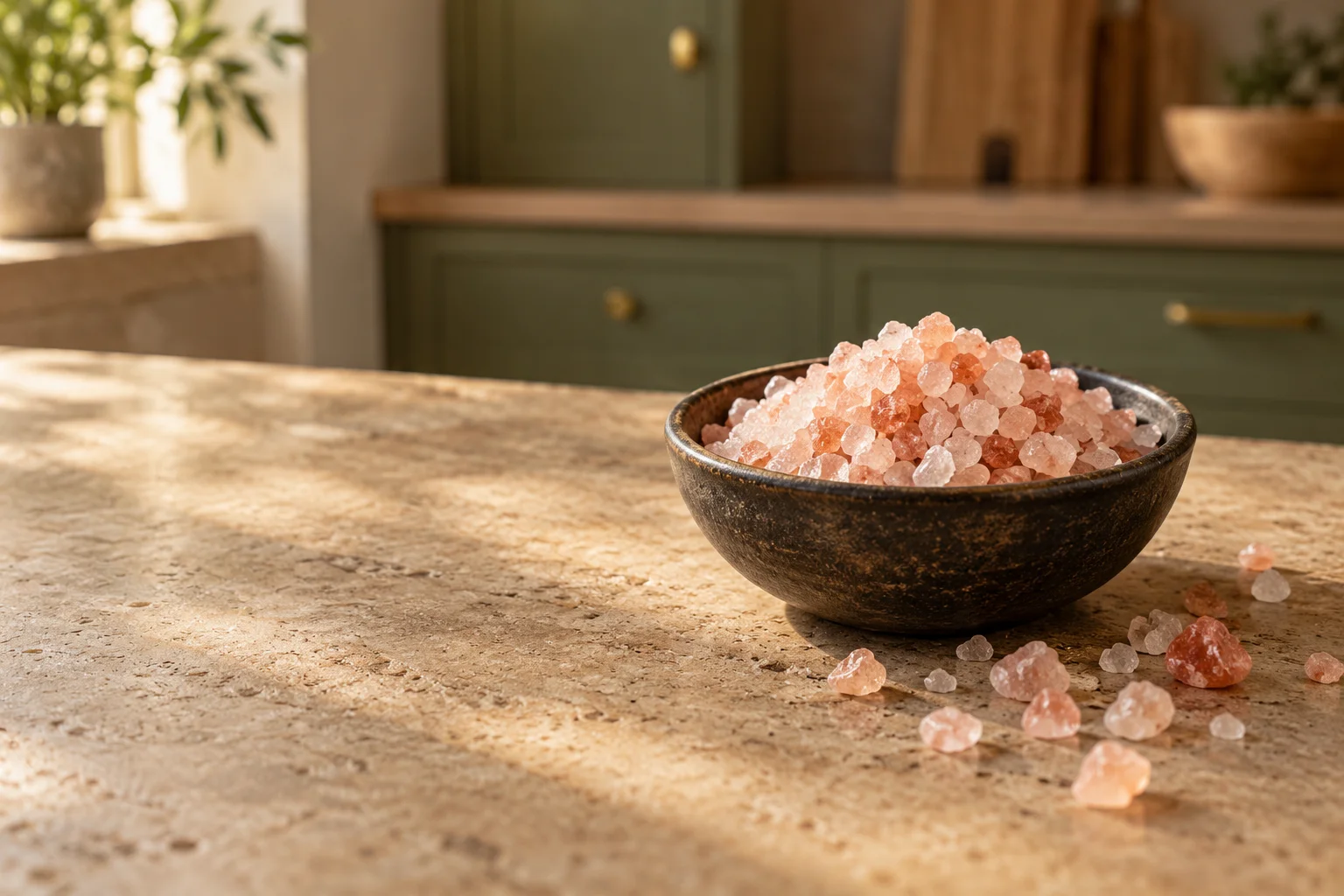
AI-generated illustration.
1065
What is it?
What shops usually call Himalayan salt is pink rock salt. It is extracted from underground salt deposits, crushed and sold as fine salt, coarse crystals or mill salt. Beneath the attractive colour, it remains primarily ordinary salt: Codex requires at least 97 percent sodium chloride in food-grade salt.
«Pink colour and straightforward facts.»
The story
The name evokes snow-covered peaks, but Khewra Pink Rock Salt is mined in Pakistan’s Salt Range. That makes the story more precise rather than less interesting. It comes from rock, not a pink snowdrift high in the Himalayas.
Flavour profile
The flavour is clean and salty. Colour, grain size and crunch are the main distinctions at the table. Large crystals give distinct salty hits. Finely ground Himalayan salt spreads more evenly and behaves much like other fine salt.
Pairs well with
Use it where the salt will be seen: on eggs, tomatoes, avocado, roast vegetables, grilled meat, fish and dark bread. It also looks good in a transparent table mill. If it will simply disappear into a large stew, a cheaper everyday salt does the same job.
Buy salt labelled for food use and choose grain size for the job: coarse for mills and visible finishing, fine for dough and even salting. If using Himalayan salt daily, check whether it is iodised. Helsenorge recommends choosing salt with iodine.
Did you know?
Pink salt contains minerals beyond sodium and chloride, but quantities are small. In one study, more than 30 grams daily, roughly six teaspoons, would have been needed for the minerals to contribute meaningfully to nutrition. That would bring far too much sodium.
Common mistakes
The biggest trap is reading “natural”, “pink” and “mineral-rich” as permission to use unlimited amounts. Your body still counts the salt. WHO recommends adults consume less than 5 grams daily. Another mistake is assuming pink salt automatically contains iodine. Read the ingredients.
Know the difference
Himalayan salt describes the type and marketed origin. Fine, coarse and flakes describe its form. Iodised means iodine has been added. Pink salt can therefore be coarse and iodised, or fine and without iodine. The front label attracts; the ingredients explain.
Fun facts
Pink salt is not one fixed natural formula. An analysis of 31 products found large variations in mineral content, with darker samples generally containing more minerals. Darker does not automatically mean better or healthier. It primarily means a different composition and more colour.
Combines well with
Pepper, lemon, garlic, rosemary, thyme, chilli and smoked paprika are reliable friends. On mild ingredients such as eggs, tomato and avocado, the pink grains also get to be seen. A little oil or butter helps salt and spices adhere.
Sapidus best friends
Himalayan salt works best on food with a settled surface and room for some crunch: grilled steak, roast potatoes, focaccia, eggs, salads and roast root vegetables. Here, both colour and crystals have a real job.
What should you avoid?
Do not pay extra for pink salt in dishes where it dissolves completely and the colour disappears. Be cautious with soy sauce, stock, cured meat and salty cheese. Buy from a reputable food supplier: in the study of 31 pink salts, one sample exceeded the Australian lead limit. This does not mean all pink salt is problematic, but reminds us that food quality matters.
Storage
Store salt clean and dry in a lidded container. Keep the mill away from pot steam. Moisture clumps crystals and can make even the finest salt mill sound as though it is chewing pebbles.
7 claims linked to sources.
Source research was AI-assisted. Explore the background and follow the links to the sources.