AI-generated illustration.
1063
What is it?
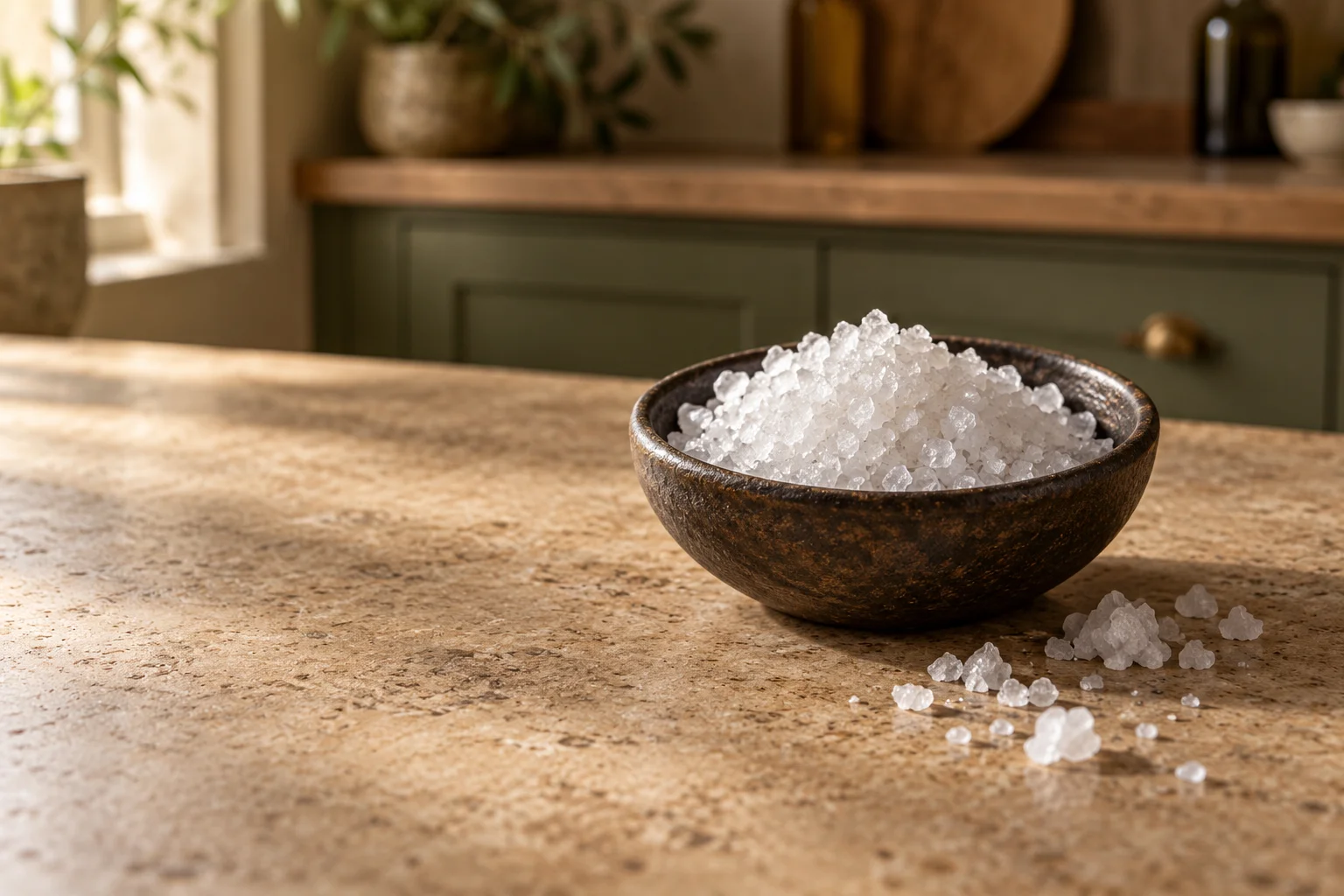
Coarse salt is ordinary salt with large crystals. The coarseness refers to size, not flavour or chemistry. Food-grade salt consists mainly of sodium chloride. Its large grains work well in mills, brines and pots where they have time to dissolve.
«Grinders, brine and large crystals.»
The story
Before refrigeration, salt was one of the most important aids to keeping food. It can make less water available to unwanted microorganisms. We still use salting and brines, but safe preservation involves more than adding salt and hoping. Temperature, acidity, time and a proven recipe also matter.
Flavour profile
Coarse salt tastes salty, but its large crystals take longer to disappear. On the surface they can provide distinct salty hits and some crunch. In water they dissolve and lose their coarseness. Crystal size and shape can influence both dissolution and the perception of saltiness.
Pairs well with
Coarse salt suits salt mills, pasta water, potato cooking water, brines and some forms of fermentation. It also works on roast root vegetables and meat when visible crystals are wanted. Fine salt is usually easier when salt must be distributed evenly through dough.
Weigh salt when making brine. A brine at 10 percent of total weight, for example, contains 100 grams of salt and 900 grams of water. Record the calculation so you can repeat it. For preservation or fermentation, follow a proven recipe rather than improvising with food safety. WHO recommends adults consume less than 5 grams of salt daily.
Did you know?
Brine can do more than salt the surface. Salt solutions are also used to influence water retention and tenderness in meat. Stronger brine is not automatically better. Too much salt or too much time can produce something closer to sandwich meat than Sunday dinner.
Common mistakes
Percentage calculations are the main stumbling block. Some recipes mean a percentage of water weight; others mean the whole brine. Unless stated otherwise, Sapidus means a percentage of total weight. Measuring coarse crystals in teaspoons is another mistake: air spaces between grains make volume unreliable. Use scales.
Know the difference
Coarse table salt is not the same as nitrite curing salt. Curing salt is a separate blend in which salt carries nitrite, used according to specific recipes. Do not swap them. Coarse salt can also be iodised; some Norwegian retail salt contains 20 micrograms of iodine per gram. Read the ingredients.
Fun facts
A salt mill makes fine salt to order. A large crystal enters at the top and emerges as smaller pieces with more surface area, helping salt dissolve and spread more readily. The mill changes its shape, not the salt itself.
Combines well with
In brine, coarse salt works well with peppercorns, bay leaves, garlic, dill, thyme, juniper and citrus zest. For vegetables, add chilli or mustard seeds. Keep the seasoning focused: the brine should provide direction rather than taste as if the entire spice cupboard fell in.
Sapidus best friends
The dream team includes potatoes, pasta, cabbage, cucumber, onions, chicken, pork, fish and root vegetables. Coarse salt is especially happy when dissolved in water or crushed in a mill before serving.
What should you avoid?
Coarse salt is inconvenient in small dough batches, cakes and spice blends that need perfectly even distribution. It is not a substitute for nitrite curing salt or other specialised salts in curing and preserving recipes. If you already use soy sauce, stock, cured meat or salty cheese, give the salt mill a quiet evening.
Storage
Store coarse salt clean and dry, preferably in a lidded container. Keep the mill away from steam from pots and washing-up. Damp crystals can clump and make the mill behave as though it has taken the weekend off.
7 claims linked to sources.
Source research was AI-assisted. Explore the background and follow the links to the sources.